This
architecture was pioneered by Professor Teuvo Kohonen at the University of
Helsinki. It is unlike the other architectures that we have met before as it
involves unsupervised training. It learns the patterns for itself without
being told what it is supposed to be learning!
In supervised learning, which is what we have been using up to now, we
train the networks by presenting them with an input pattern together with a
corresponding output pattern, and the networks adjust their connections so as to
learn the relationship. However, with the Self-Organising Map (SOM), we just
give it a series of input patterns, and it learns for itself how to group these
together so that similar patterns produce similar outputs.
It's about time that we saw for ourselves what the SOM looks like ....
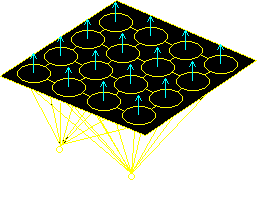
Well, that's the Kohonen SOM on the right. It consists
of a single layer of cells, all of which are connected to a series of
inputs. The inputs themselves are not cells and do no processing - they
are just the points where the input signal enters the system.
The cells in the diagram appear to have connections between them (and
indeed, descriptions of Kohonen nets I have read generally refer to
"lateral inhibitory connections"), but the algorithm for training the net
never mentions them, and so, I shan't refer to them again!
Training the Kohonen SOM
The SOM is generally
speaking a two-dimensional structure - a rectangular grid of cells - which
allows "blobs" of activity to appear on its surface and represent groupings. If
it were three dimensions or more, then it would be hard for anyone to visualise
the patterns of activity.
However, for the purposes of describing the training algorithm, I shall use a
one-dimensional example. The idea behind the training is that the weights
(strengths of connections between the inputs and each of the nodes in the grid)
are set to random values. Then the patterns are presented one after each other.
Each pattern is "run forward" in the net, so that the net produces an output.
Although the weights are random, one of the nodes has to produce a slightly
higher output than the others, and that node is chosen as the "winner." The
weights of the winning node and those in its immediate neighbourhood are updated
slightly so that they are more likely to correspond to the input pattern in
future. In this way, groups of nodes across the SOM become dedicated to classes
of input pattern and those similar to them.
Initialise the network
Let's say that wij is the weight from input number
i to cell number j. We will also assume that
there are n input values,
and number them from 1 to n.
These weights are set up to be small random values. No reference paper has
ever told me exactly how small "small" is, so I tend to make them very
small, i.e. some random number in the range 0 to 0.01. We also have to decide
upon the size of the neighbourhood of each cell, which we call for cell j, N. This is set to a large value (typically almost
the size of the entire grid). I have chosen to implement the size in terms of
a radius, i.e. a distance from the central winning node.
const n = 2;           {How many inputs}
      NUMCELLS = 10;   {How many cells in grid}

var radius : byte;
var w : array [1..M, 1..NUMCELLS] of real;

      .....

procedure initialise;
var i,j : byte;
begin for i := 1 to n do
       for j := 1 to NUMCELLS do
        w[i,j] := random(100) / 10000; {Range 0 to 0.01}
      radius := NUMCELLS div 2 - 1;    {Try 4}
end;
Present input
Present the first input pattern, which we call x1 to xn, where xi is the input to mode i. We don't seem to need to run
the network forward, as far as I can see.
var x : array [1..n] of real; {Contains input}
Calculate distances
Calculate the distances between the input and each of the output nodes in
turn. We produce a distance figure for each cell j, and do it by going through all the inputs and
adding the squares of the differences between the input value and the weight
(yes, I kid you not - the weight, not the output value!). As an equation, this
is written as follows:
dj =
n-1 S 0
(xi -
wij)2
and if you prefer that in non-gobbledy gook,
var d : array [1..NUMCELLS] of real;    {Contains differences}

....

for j := 1 to NUMCELLS do
 begin d[j] := 0;
       for i := 1 to n do
        d[j] := d[j] + (x[i] - w[i,j]) * (x[i] - w[i,j])
                       {This last part squares x[i] - w[i,j]}
 end;
Select the minimum distance
Find the cell with the minimum difference, and call that node j*
var j_star : byte;
    temp_d : real;

....

{Set temp_d to a dummy high distance value}
temp_d := 10000;
for j := 1 to NUMCELLS do
 if d[j] < temp_d    {Bound to happen sooner or later}
  then begin temp_d := d[j];
             j_star := j
       end;
Update the weights
Update the weights for node j* and all the nodes in the same
neighbourhood (as defined by the size of N. New weights are given by the following formula
new wij = old wij + h(xi - wij)
The weights that are not in the neighbourhood are not changed at all. h is a gain term between 0 and 1 which
decreases slowly over time, thereby slowing down the rate at which weights
adapt. The size of the neighbourhood, N also decreases slowly as time goes on, thus
localising the area of maximum activity. Unfortunately, Kohonen and those that
have come after him have stated that there are "no hard and fast rules"
determining how quickly and at what point these values should decrease.
Repeat the process
Repeat the process by going back to step 2. You should present different
input patterns cyclically (no, not using ESP, just cycle through the patterns:
1, 2, 3, 1, 2, 3 etc.) and at regular intervals (undefined) reduce the
neighbourhood size and gain term. The convergence does seem to be rather slow
- typically a few hundred cycles should happen before these sizes are reduced
at all.
Running the Kohonen SOM
This part I have
never seen in any literature about SOMs - not once. Nobody seems to write about
it, so I have had to work out the rule for myself. However, it does seem to
work.
To calculate the output for each cell, just apply the required input to all
the nodes. Then, for each cell in the grid, multiply corresponding inputs and
weights, and sum the values, and that is the output for that node. There doesn't
seem to be any need for a transfer function.
for j := 1 to NUMCELLS do
 begin sum := 0.0;
       for i := 1 to n do
        sum := sum + w[i,j] * x[i];  {Weight times input}
       writeln('Output for cell ' + j + ' : ' + sum)
 end
We can't guarantee that the output of the cells will be in the range 0.0 to
1.0. It may be above 1.0, so there may be occasions where you have to impose a
ceiling on it. In the example below, I artificially impose a ceiling of 1.0 so
that the pictures are displayed correctly.
An example of a Kohonen SOM
This example
shows a JavaScript version of the one-dimensional SOM that I have just
described. It has 10 output cells and two inputs. During training, the program
is designed to present two types of input to the SOM, either the first input
high (in the range 0.8 to 1.0) and the second low (0.0 to 0.2) or vice-versa.
Two inputs:
Initial range (2-4)
Iterations
To see how this program works, view the source code and use the Search
facility (F3 in Notepad) to search for the string <!--
This is the code!! -->.
A two-dimensional Kohonen SOM
The Kohonen SOM
really comes into its own with a two-dimensional grid of cells. The example I
have included below is similar to the one dimensional example except that all
the variables have been given the suffix '2' to distinguish them from the
variables in the one-dimensional example. For instance, the weights are stored
in the array w2. However,
the input still uses the array x.
This time the input consists of four groups of numbers: Low-low, Low-high,
High-low and High-high, created in the same manner as before. We should
find that four large "islands" of activation form in the grid, although we can't
predict exactly where.
Two inputs:
Initial range (2-4)
Iterations
N.B. Some academic literature refers to the SOM as a
Self-Organising Feature Map (SOFM), so consider this alternative
name when you search for them with a search
engine.


 Main Menu