|
 |
| ||||
|
Proc Natl Acad Sci U S A. 2001 August 14; 98(17): 9490–9493.
doi:
10.1073/pnas.171317798. Copyright
© 2001, The National Academy of Sciences
Physics
Quantum optical implementation of Grover's
algorithm
‡To whom reprint requests may
be addressed. E-mail: scully/at/physics.tamu.edu
or zubairy/at/physics.tamu.edu
.
Contributed by Marlan O. Scully Accepted June 21, 2001. | |||||||||||||||||||||||||||||||||||||
|
Abstract
We present a scheme for a quantum optical
implementation of Grover's algorithm based on resonant atomic interactions
with classical fields and dispersive couplings with quantized cavity
fields. The proposed scheme depends on preparation of entangled states and
is within current state-of-the-art technology. | |||||||||||||||||||||||||||||||||||||
|
As was first shown by Grover (1),
search of a database by using quantum mechanics can be substantially
faster than any classical search of unsorted data. For example, it was
shown by Grover that, by using quantum superpositions and quantum
entanglement, we can find an object in an unsorted database containing
N objects in O( The implementation of search algorithms by using optical methods is a subject of intense interest (4–8), and Grover's search algorithm has been implemented by using nuclear magnetic resonance (NMR) techniques for a system with four states (9–11). However, NMR experiments for quantum computing are carried out at room temperature, and questions have been raised concerning the appearance of entanglement in the physical state at any stage of such experiments (12). Braunstein et al. show that “all states so far used in NMR for quantum computations or for other quantum-information protocols are separable,” and therefore “no entanglement appears in the physical states at any stage of present NMR experiments.” In this paper, we propose a scheme for quantum optical implementation of Grover's algorithm that is not sensitive to such thermal decoherence effects. The scheme is based on resonant atomic interactions with classical fields and dispersive coupling with quantized cavity fields. We first formulate the problem in terms of a “circuit” logic involving one-bit unitary transformation and a two-bit quantum phase gate. For an atomic system, the one-bit unitary transformation is accomplished by means of resonant interaction with a classical field, whereas a quantum phase gate can be implemented by using dispersive coupling with a cavity field having either 0 or 1 photon. Such a quantum phase gate has been demonstrated recently [for a beautiful demonstration of quantum phase gate, see Rauschenbeutel et al. (13); conditional phase shifts are also demonstrated in Turchette et al. (14)]. The proposed scheme involving atomic interaction with classical field and two cavities therefore lies within present experimental limitations and should be realizable (15). Grover proposed an algorithm to search an item in an unsorted database.
The problem he addressed is as follows. We are given a function
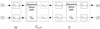
f(x) with x = 1, 2 The basic idea of Grover's algorithm is to invert the phase (e.g., change + → −, as in the passage from Eqs. 6 to 8) of the desired basis state and then invert all the basis states about the average amplitude of all the states. In this paper, we restrict ourselves to the simplest interesting Grover's algorithm with N = 4 with two qubits. First, we discuss the implementation of Grover's algorithm in terms of quantum logic gates. A universal quantum computer consists of only two gates, namely a unitary transformation (one-bit gate) and a two-bit conditional quantum phase gate. The one-bit quantum gate for the ith qubit is given by
![[var phi]](Quantum optical implementation of Grover's algorithm.files/x03C6.gif) in terms of Pauli spin matrices is given by in terms of Pauli spin matrices is given by
 α,β flips the sign of state |α, β > (α = 0 or 1 and
β = 0 or 1). In the original Grover's algorithm, this is accomplished
through operator (1 − 2|α, β > < α, β|). Here we follow a different
approach. We first flip the sign of state |1, 1 > via a quantum phase
gate Qπ, followed by unitary operators that either
retain the state of the qubit or change the state of the qubit from 0 to 1
and 1 to 0. The sign flip operators for the four possible states in this
approach are given by α,β flips the sign of state |α, β > (α = 0 or 1 and
β = 0 or 1). In the original Grover's algorithm, this is accomplished
through operator (1 − 2|α, β > < α, β|). Here we follow a different
approach. We first flip the sign of state |1, 1 > via a quantum phase
gate Qπ, followed by unitary operators that either
retain the state of the qubit or change the state of the qubit from 0 to 1
and 1 to 0. The sign flip operators for the four possible states in this
approach are given by
At this point, the oracle applies one of the Cα,β operators to state 6 and thus changes one of the signs from + to −. For example, if C0,1 is chosen, then Eq. 6 becomes
 = 1 − 2|s >< s|. The resulting state is
the desired state |a, b > apart from an unimportant π
phase shift. To find a representation for in terms of operators Uθ, and Qπ, we first note that = 1 − 2|s >< s|. The resulting state is
the desired state |a, b > apart from an unimportant π
phase shift. To find a representation for in terms of operators Uθ, and Qπ, we first note that
C0,1|s >= −|0, 1 >. If we use
the fact that rotating σz about the y axis
yields σx, that is,
as given by Eq. 9
is the appropriately rotated quantum phase operator Qπ
of Eq. 7b,
i.e.,
On combining the various operators from Eqs. 5,
7, and 11,
we can write Grover's algorithm in terms of simple transformations
corresponding to one- and two-bit quantum gates as
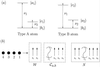
Next, we consider schemes for the implementation of Grover's algorithm on the basis of cavity quantum electrodynamics (16–20), using resonant atomic interaction with classical Ramsey fields and dispersive atomic interaction with quantized high Q cavity fields. First, we present a scheme that requires two species of atoms and two cavities. This scheme is conceptually simple but difficult to implement. We then consider a second scheme that requires single species of atoms interacting with only one cavity that supports two modes, and the atomic level spacings are appropriately changed by electric or magnetic fields. First, we consider the schematic for the proposed implementation as given in Fig. 2. The two qubits are represented by two different three-level atoms of types A and B (Fig. 2a). Levels |a > and |b > of these atoms represent qubits |0 > and |1 >, respectively. The levels scheme is such that ωa1b1 = ωc2b2 + Δ1 and ωa2b2 = ωc1b1 + Δ2. Cavities C1 and C2 are resonant with transitions ωa1b1 and ωa2b2, respectively. Here, and in the following, the odd subscripts 1, 3, 5, and 7 refer to the atom, cavity, and classical fields corresponding to the atoms of type A, whereas the even subscripts 2, 4, 6, and 8 refer to atoms of type B. Four atoms (two of type A and two of type B) pass through cavities C1 and C2 and a sequence of classical fields, as follows (Fig. 2b).
All the atoms are initially in their ground states |b >,
i.e., |b1, b2,
b3, b4 >, and we assume that
the classical Ramsey fields are on only when the appropriate atoms are
passing through them. Atom 1 of type A and atom 2 of type
B are initially in their ground states |b1
> and |b2 >, i.e., in qubits |1, 1 >. The
Walsh–Hadamard transformation on these atoms is carried out by interacting
with classical fields R1 and R2 of
frequencies ωa1b1 and
ωa2b2, respectively.
The interaction of an atom with the classical field results in the unitary
transformation (Eq. 1)
on the atomic states |a > and |b >, such that θ
depends on the Rabi frequency and the interaction time, and In the next step, we consider operation
 (|01, a2 > +|01,
b2 > +|11, a2 >
+eiη|11, b2
>), where η = g2τ/Δ1. The net result is
that there is no photon number change inside the cavity, and there is a
phase change only when there is one photon inside the cavity and the atom
is in state |b2 >. Interaction time τ and detuning
Δ1 are chosen such that η = π. This operation corresponds to
the quantum phase gate discussed above and experimentally implemented in
refs. 13
and 14. (|01, a2 > +|01,
b2 > +|11, a2 >
+eiη|11, b2
>), where η = g2τ/Δ1. The net result is
that there is no photon number change inside the cavity, and there is a
phase change only when there is one photon inside the cavity and the atom
is in state |b2 >. Interaction time τ and detuning
Δ1 are chosen such that η = π. This operation corresponds to
the quantum phase gate discussed above and experimentally implemented in
refs. 13
and 14.
Atom 3 of type A in ground state |b3 >
now passes through cavity C1, followed by a classical
field RC1. The interaction times
with the cavity and classical fields are such that the cavity field is
reduced to |0 >, and the resultant entangled state between atoms 2 and
3 is given by (|a3, a2 >
+|a3, b2 >
+|b3, a2 >
−|b3, b2 >)/2. Here and in the
following, we neglect the unimportant overall phase factor. Now Next, we implement operator According to Eq. 12, we should next apply a quantum phase gate Qα with α = π. This step is accomplished as above by first transferring the atomic coherence of atom 2 to the empty cavity C2 by adjusting the interaction time with the cavity appropriately. And then, on passing atom 3 through cavity C2, the entangled state of atom 3 and cavity C2 is (|a3, 02 > −|a3, 12 > +|b3, 02 > −|b3, 12 >)/2. Subsequently, a fourth atom of type B passes through cavity
C2, and a classical field,
RC2, leaves the cavity empty and
transfers the field coherence to the atom yielding
(|a3, a4 >
−|a3, b4 >
+|b3, a4 >
−|b3, b4 >)/2. As a last step,
atoms 3 and 4 pass through a sequence of classical fields,
R7, resonant with |a > to |b >
transitions of atom 3 and R8 resonant with |a
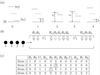
> to |b > transitions of atom 4, such that θ = π/4, Motivated by the above scheme, we consider an equivalent scheme that requires only one species of atoms and a single cavity, as shown in Fig. 3. Here the atoms have one lower level and two excited levels, whose splitting can be adjusted by applying electric or magnetic fields (23). These Stark or Zeeman splittings can be used to carry out resonant or dispersive atomic couplings with the cavity fields.
We consider a cavity that can support two modes of frequencies ν1 and ν2. The three-level atoms having a lower level |b > and two upper levels |a1 > and |a2 > can have level spacings that depend on the applied electric or magnetic fields, as shown in Fig. 3a. Level |b > corresponds to qubit |1 >, and levels |a1 > and |a2 > correspond to qubit |0 > for atoms 1 and 3 and atoms 2 and 4, respectively. In configuration 0, levels |a1 > and |a2 > are completely detuned with respect to cavity resonance frequencies ν1 and ν2, and the atom is effectively decoupled from the cavity fields. In configuration 1, the atom resonantly interacts with ν1 but is decoupled with ν2. In configuration 2, the atom interacts dispersively with ν2 but is decoupled with ν1. Similarly, in configurations 3 and 4, the atom interacts resonantly with ν2 with no interaction with ν1, dispersively with ν1, and with no interaction with ν2. As before, four atoms are sent inside the cavity initially in their ground state |b > such that they interact with a sequence of classical driving fields Ri (i = 1 − 8) and cavity fields C1 and C2 of frequencies ν1 and ν2, respectively, as shown in Fig. 3b. The interaction times are the same as in the first scheme. The appropriate interactions leading to the implementation of Grover's algorithm corresponding to the first scheme are obtained if the sequence of the atomic level spacings during the passage through Ri and Ci is chosen for various atoms as that given in Fig. 3c. In conclusion, we have shown how Grover's algorithm can be implemented by using the known methods and techniques of quantum optics. Limitations are imposed by considerations of spontaneous emission and by cavity field damping. A potential source of error is the uncertainty associated with the location of atoms in the various fields. | |||||||||||||||||||||||||||||||||||||
|
Acknowledgments
We thank L. Davidovich, J. Dowling, K. Kapale, H. Lee, and C. P. Williams for valuable discussions. This research is supported by the Office of Naval Research, the National Science Foundation, and the Welch Foundation. | |||||||||||||||||||||||||||||||||||||
|
References
1.
Grover L K. Phys Rev Lett. 1997;79:325–328. 2.
Farhi E, Gutmann S. Phys Rev A.
1998;57:2403–2406. 3.
Lloyd S. Phys Rev A. 2000;61:0103011–0103014. 4.
Kwiat P G, Mitchell J R, Schwindt P D D, White A G.
J Mod Optics.
1999;47:257–266. 5.
Cerf N J, Adami C, Kwiat P G. Phys Rev A.
1998;57:R1477–R1480. 6.
Ahn J, Weinacht T C, Bucksbaum P H. Science.
2000;287:463–465. [PubMed] 7.
Knight P. Science. 2000;287:441–442. 8.
Scully M O, Zubairy M S. Phys Rev A.
2001;64:0223041–0223045. 9.
Chuang I L, Gershenfeld N, Kubinec M. Phys Rev Lett.
1998;80:3408–3411. 10.
Jones J A, Mosca M, Hansen R H. Nature (London).
1998;393:344. 11.
Jones J A. Science. 1998;280:229. 12.
Braunstein S L, Caves C M, Jozsa R, Linden N, Popescu
S, Schack R. Phys Rev Lett. 1999;83:1054–1057. 13.
Rauschenbeutel A, Nogues G, Osnaghi S, Bertet P, Brune
M, Raimond J M, Haroche S. Phys Rev Lett. 1999;83:5166–5169. 14.
Turchette Q A, Hood C J, Lange W, Mabuchi H, Kimble H
J. Phys Rev
Lett. 1995;75:4710–4713. [PubMed] 15.
Skarja M, Borstnik N M, Loffler M, Walther H. Phys Rev A.
1999;60:3229–3232. 16.
Meschede D, Walther H, Muller G. Phys Rev Lett.
1985;54:551–554. [PubMed] 17.
Haroche, S.; Raimond, J M. Advances in Atomic, Molecular, and Optical
Physics. Bates D R, Bederson B. , editors. Vol. 20. New York:
Academic; 1985. p. 350. 18.
An K, Childs J J, Desari R R, Feld M S. Phys Rev Lett.
1994;73:3375–3378. [PubMed] 19.
Raithel, G.;Wagner, C.;Walther, H.;Narducci, L M.;
Scully, M O. Advances in Atomic, Molecular, and
Optical Physics. Berman P. , editor. New York: Academic; 1994. ,
Suppl. 2, p. 57. 20.
Hood C J, Chapman M S, Lynn T W, Kimble H J. Phys Rev Lett.
1998;80:4157–4160. 21.
Brune M, Haroche S, Lefevre V, Raimond J M, Zagury N.
Phys Rev Lett.
1990;65:976–979. [PubMed] 22.
Scully, M O.; Zubairy, M S. Quantum Optics. London: Cambridge; 1997.
23.
Maitre X, Hagley E, Nogues G, Wunderlich C, Goy P,
Brune M, Raimond J M, Haroche S. Phys Rev Lett. 1997;79:769–772. | |||||||||||||||||||||||||||||||||||||

 |1, 1 >= eiψ|α, β >, where ψ
is a phase depending on the choice of α and β. These steps are summarized
in the “circuit” diagram of Fig.
|1, 1 >= eiψ|α, β >, where ψ
is a phase depending on the choice of α and β. These steps are summarized
in the “circuit” diagram of Fig.