


Section 3.4
described that we chose the ML (or, equivalently, minimum entropy) value of the
Gaussian-kernel standard-deviation  .
We have found that for sufficiently large sample size
.
We have found that for sufficiently large sample size  , the choice of
is not sensitive to the value of , thereby enabling us to automatically set
to an appropriate value before the processing begins. Figure 3.2(b)
depicts this behavior. Thus, given the Markov neighborhood and the
local-sampling Gaussian variance, the method chooses the critical Parzen-window
kernel parameters
and automatically in a data-driven fashion using
information-theoretic metrics.
, the choice of
is not sensitive to the value of , thereby enabling us to automatically set
to an appropriate value before the processing begins. Figure 3.2(b)
depicts this behavior. Thus, given the Markov neighborhood and the
local-sampling Gaussian variance, the method chooses the critical Parzen-window
kernel parameters
and automatically in a data-driven fashion using
information-theoretic metrics.
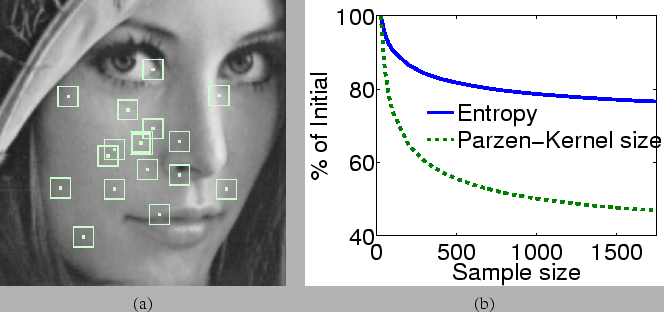 |
 (black dots) along with the neighborhoods (squares around the dots)
that form the Parzen-window sample for pixel
(black dots) along with the neighborhoods (squares around the dots)
that form the Parzen-window sample for pixel  (square with thickest edges). (b) The entropy of the Markov PDF
and the optimal
(square with thickest edges). (b) The entropy of the Markov PDF
and the optimal  . (To give smoother curves, each measurement, for a particular