| Map
of Visual Cortical Regions |
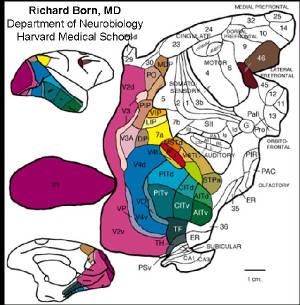
|
| from Richard Born lab, Dept. Neurobiology,
HMS |
Clearly the vast
majority of vertebrate information processing
is done at the "subconsicous" level. Not only are we not
aware of the detailed neuronal firing patterns in (e.g.)
visual cortical areas V1, V2, V4, MT, etc., etc., we indeed
have no apparent way of ever consciously "accessing" this
information.
Our "consciousness experience" clearly has
access to the highly processed results of "lower level" (??)
information processing, and can operate in the
linguistic-thought realms, but IS information processing per
se done at the "conscious level"? If so, how much
information is processed at this level?
Taking a pragmatic view that our thoughts
have some mechanistic function (as
opposed to pure epiphenomenalism), we can ask what substantial
tasks our thought processes play and how this relates to
things that are obligately "conscious" thought processes
in the sense that if we don't pay conscious heed to them, we
cannot perform them, e.g. I could not write this text absent
some dedication of "conscious" or attentional resources.
[this question is relevant even in the epiphenomenalist's
view, assuming that the neural processes underlying the
epiP. "sensation" of conscious info processing
reflects neural processes distinct from those that do
not reach the level of conscious experience or
awareness].
But what are obligate
self-conscious processes?
There are certain mental operations that
require "deliberate focused effort" in order to be
accomplished. This immediately ties into attentional
mechanisms and may relate to the so-called "neural correlates
of consciousness" purveyed by Koch and co-workers. This
attentional system might be viewed as a quite limited RAM memory into which we can read
and write-- a sketchpad if you will whose capacity is vastly
inferior to our RoM (memories). The extent of our
sketchpad is reflected by the extent of concepts or numbers
that we can hold at one time (7 or 8 or so) reflecting just a
few bytes of information, which seems intellectually puny--
especially given that our operations in this sketchpad are
largely serial in nature. So how did we become Masters
of the Universe with a sketchpad that the simplest pocket
calculators would laugh at? This is one of the deeper
mysteries of neuroscience and relates directly to the issue of
conscious vs. subconscious processing of
information.
We
have something that no extant or practically envisioned
computer can or will have: massively diverse and highly
specific and vast neural interconnections and
algorithms which abstract higher order patterns from our
worlds. We also have powerful learning algorithms
supported by the horrendous complexity of the cortical column,
which is itself just a simple processing unit that contributes
to the horrendous complexity that is
cortex-thalamus-cerebellum, as guided by reward-based
limbic mechanisms. It is the details of these
architectures that allow us puny sketch-pad creatures to be
Masters of the Universe-- for now. The issue is not
whether or not such skills can be implemented in silico, but
rather the big issue is this: can in silico creatures
(DEs and the like) be made vastly more powerful because their
sketchpads can operate in the terrabyte range vs. the human
handful of bytes range? The answer to this question lies
in understanding exactly how conscious information processing
interfaces with the subconscious. Is there
something in the nature of this information processing
structure that formally precludes massive scale
up?
Peter Somogyi
recently presented a detailed accounting of hippocampal
microcircuitry (CSHL, 2006 meeting: neuronal circuits:from
structure to function). He focused on just a few of the
16 defined types of hippocampal interneurons. The gist
of this talk eluded me, but it did seem that there were
complex phase relationships between different neuronal
subtypes and the ongoing cortical electrical rhythms, which
play a dominant role in our conscious levels of information
processing. One view of anesthesia is that it
represents a fragmentation of the normally cohesive intra- and
inter-hemispheric neural activity patterns (George Mashour,
Senior Anesth. resident of MGH in spring 2006).
Thus the issue becomes how the details of the hippocampal
microcircuit (or cortical column) working in massive tandem
via global mechanisms that tie all brain regions together
(unless fragmented by anesthesia or a bump on the head)
combine to produce this "puny
sketchpad". [note: physicist's description
of scale-free network dynamics may be relevant to this system;
check with Armen Stepanyants for contact info].
The gist here is that the puny sketchpad is
perhaps just a tip of a much more massive subconscious
sketchpad that is performing triage on candidate words, ideas
and judgments and filtering the best candidates up to the puny
sketchpad for final deliberations/decisions. Our
ability to recall only short sequences of digits is thus
highly misleading: this narrow
application/result masks the true purpose and
complexity of this system. None of this materially
addresses the question of whether the conscious sketchpad
actually does ANY information processing (from either
materialist or epiP views), but the larger point has already
been made: the complexity of the neural structures at
the local and global levels is what gives rise to our
cognitive capabilities. The issue of
conscious IP will have to rest on the back burner of my
subconscious for now.
TBA:
Shannon information theory -- vs. thought-info
disconnect.
1/ln(P) view of information seems inapplicable
Consc. as an attention-focusing mechanism.
[relates well to Consc. as vertebrate
dec. making device]
| good source for idle meanderings |
|
|
The answer to the Semantics problem [How do we get
Semantics from Syntax] seems simple enough to me:
Semantics Comes from
Experience. This sounds obvious once
stated, although I could not find any prior claim that this is
so in a casual google search**; and I have certainly not
scoured the vast neurophilosophical literature for this
phrase. This statement might be trivialized to mean "we
learn stuff and then it has meaning", but that misses the
point. The point is that the syntax comes to have
meaning as we build it into information processing structures
that are interfaced to motor and reward systems. In some
cases (instinct) the experience is that acquired over
evolutionary time and so we know that a moist tit is a
good thing absent our own Personal experience.
Just as a larval zebrafish knows that a paramecium is a good
think to track and eat based on the barest amount of visual
information with which it had no prior experience (McElligott
and O'Malley, 2005). This is something quite beyond Eric
Baum's view of inductive bias channeling our learning
abilities to suit specific needs, true though that may
be. Pure instinct is devoid of any individual learning:
it is coded into our genome and expressed via the process of
neural development.
Dennett and
Dretske have had lively exchanges on the nature and role
of "meaning", but it seems to be just another way of
discussing the semantics from syntax problem. Here is
how you build sentient machines: build digital architectures
equivalent to our cortical columns and cortex and give them
experiences, like you would any human infant. An
alternative approach is the chip-replacement man, where you
substitute into my brain perfect neuronal replicas, one neuron
at a time, until I am wholly artificial. In this case,
you have not given me any new experiences, just replaced my
biological memory core with a digital one. Ultimately it
seems like things "mean" something to us because we are
conscious of their "meaning", like the smoke alarm beeping
telling me I should stop writing now, but Bayes' rule applies
and it is all but action potentials and probabilities-- it is
all syntax...syntax that means something. This is just a
re-statement of the core problem of "what is consciousness",
we cannot solve one problem without solving the
other.
Stuff in the world
has meaning because we are conscious of that stuff and we
have experiences that give that stuff meaning...absent
consciousness there is no meaning, or at least no meaning of
which we can be aware, because we are not aware.
This does not rule out the idea of even quite simple
animals having both consciousness and meaning.
** The only instance of "semantics comes from experience"
that I found on Google was in a Java distance-learning course,
and while this has nothing specifically to do with the
mind-body problem, it is indeed quite relevant to the
discussion at hand. In this posting by a Kenneth A.
Kousen (aka gunslinger), he says that you can best learn Java
syntax by reading many examples. In our case we argue
that the syntax (labeled lines of sensory information;
rewarding vs. aversive stimuli, temporal coincidences encoded
by STDP, or LTP as it used to be called) leads to complex
relationships. I know that the whee-uuuu, whee-uuu that
I just heard was not a fire alarm in my bldg but rather a
siren somewhere down Huntington avenue in Boston. I know
this not just because I've seen ambulances going whee-uuuu
down the street, but because I know what wheels and roads and
hospitals and bodies and doctors and more all are. The
really interesting thing here is not YOUR brain-- it is the
brain of your infant son or daughter. This is where
syntax becomes semantics-- where the first semantics of walls
and floors and sharp and soft and wet and dry and pain and
hunger and warmth begin to emerge out of the cacophony of
sensory stimuli, internal signals and temporal
relationships. What I want to know is how the infant's
cortical columns work and how these columns talk to one
another, as informed by thalamic gating and intermittent
reward systems. This has nothing to do with language
because language is a good year away at this point; maybe 2 or
3 depending on the infant. I can only imagine the
wonderful pleasure that my little Liam experiences at those
calm gentle moments when he leans against me and gurgles with
joyous content.
Semantics Comes from
Experience -- Java style
...
The issue of Consc. vs. Subconsc. IP (information
processing) is curious in the realm of trying to probe deeper
into one's IP activities, i.e. in terms of getting deeper into
the substance and details of that material that produces
thought.
My sense is that there is
an information "firewall": you can hone in on certain sensory
experiences, but you cannot hone in on whether this
information is being processed in the olfactory bulb or
inferior colliculus: you can say nothing about the locus of
this processing even if you sink into the deepest depths of
meditation where you are able to control heart-rate and
metabolic functions: you can control these things but you
cannot order action potentials to traverse the trigeminal
nerve rather than the vagus nerve. This firewall
sets the boundaries between subconsc. vs. consc. IP.
Even if all thought and decision making are epiP, they are
still the result of information processing by the
structure(s) that make information processing in these neural
realms possible. We can experience these aspects of
information processing, yet we are shut out from the other
(lower?) realms of subconsc. IP. Possibly, exploration
of this avenue may lead to insight into how these two realms
interact-- and possibly this may lead towards those
core neural ingredients (anatomical structures
and activity patterns) that allowed this particular
set of hominids to develop tool making, language and culture
to its current state. When machines can have such skills
and do such things, they will have what we have plus
memories and processing speeds that compare to us, in the
same manner that we compare to the CNS of the larval
zebrafish or to some tiny ant. Since computational
neuroscience, Blue Brain and Allen brain projects and the like
are going to move forward regardless of what I do, I should at
least paint a detailed enough canvas of this future that at
least SOME HUMANS, in positions of authority, will consider
the nature and imminence of this problem.
Consc. vs. Subconsc.
Decision Making.
The process
of decision making seems to be intimately associated with
consciousness in humans, although we can say nothing about
whether or not dogs or chimps engage in "conscious decision
making" (which is something the materialists should seriously
choke on!). But in humans, we have the experience of
reflecting upon things (slow decisions) and changing
directions in various situations (fast decisions) and lots of
other variations where we are thinking about things and
decisions happen. The role of consciousness in these
decisions is hard to pin down, but as noted at the bottom of
the What it is Like to be a Chair page,
being in a conscious state is essential to making good
decisions. Certainly, the idea of making
"Decisions" is fuzzily defined, in that knee jerk or escape
"reflexes" would be viewed by most as involuntary and
therefore non-decisional, whereas "deciding what TV channel to
switch to" would be considered more voluntary. As I
don't have a handy solution to the free will-automaton problem, we
will instead adopt the convention that if a choice need to be
made (e.g. whether to flee or attack; which prey item to
strike), then a decision has been made, free will or no free
will. [Do machine using complex logic circuits imbued
with countless stochastic elements (like our neurons) have
free will? Not my yob!]
The next question is do we make
involuntary decisions. For example, in regards to the
what it is like to be a chair page,
decisions were made that were perhaps instantaneous (I won't
say in case you have not yet read the page). Indeed
things that were at one time "conscious decision" can seem to
become subconsc. in that we give no conscious thought or
effort to them. This is most apparent perhaps in the
motor realm, although there are also purely mental decisions
that can be made that require no motor activity. This is
yet another clue perhaps into the murky question of what it is
that consciousness is. At some point consciousness is
necessary for some decisions, and later on it becomes rote and
subconscious. How might this happen. Moreover,
certain decisions seem to have a level of complexity that
they would never become subconscious (like deciding
which jobs to apply for, in case anyone from my work
ever reads this). But maybe even the
most "complex decisions" can become rote and subconscious
if you do them often enough?
In this vein,
consciousness is used to make decisions about new things and
new combinations of things, and when things achieve a
sufficient degree of roteness, they drop into the subconscious
realm. This is interesting because it ties
into Paul Adams view (syndar.org) that a special
kind of learning (the highest level I might say, given my lack
of understanding of his work) occurs only very
infrequently and it is for exactly these kinds of tasks that
the mechanism of conscious, focused attention becomes
involved. Adam's synaptic learning involves very
specific kinds of interactions between circuits in different
cortical layers that extract higher order statistics from
sensory and prior experiences. Perhaps these kinds of
activity have a special relationship to consciousness and/or
attention?
alternatively: dm is subconsc. and consc. only steers
attention?
|