|
|
|
|
|
J Neurosci. Author manuscript; available in
PMC 2008 June 26.
Published in final edited form as:
doi:
10.1523/JNEUROSCI.3410-07.2008. |
PMCID: PMC2440636
NIHMSID:
NIHMS49282 |
Mitogen-Activated Protein Kinase Is a Functional
Component of the Autonomous Circadian System in the Suprachiasmatic
Nucleus
Makoto
Akashi,1* Naoto Hayasaka,3*
Shin Yamazaki,4 and Koichi Node2
1Department of Vascular Failure Research,
Faculty of Medicine, Saga University, Saga 849-8501, Japan
2Department of Cardiovascular and Renal
Medicine, Faculty of Medicine, Saga University, Saga 849-8501, Japan
3Department of Anatomy and Neurobiology,
Kinki University School of Medicine, Osaka-Sayama, Osaka 589-8511,
Japan
4Department of Biological Sciences,
Vanderbilt University, Nashville, Tennessee 37235
|
|
Abstract
The suprachiasmatic
nucleus (SCN) is the master circadian pacemaker driving behavioral and
physiological rhythms in mammals. Circadian activation of
mitogen-activated protein kinase [MAPK; also known as ERK (extracellular
signal-regulated kinase)] is observed in vivo in the SCN under
constant darkness, although the biological significance of this remains
unclear. To elucidate this question, we first examined whether MAPK was
autonomously activated in ex vivo SCN slices. Moreover, we
investigated the effect of MAPK inhibition on circadian clock gene
expression and neuronal firing rhythms using SCN-slice culture systems. We
show herein that MAPK is autonomously activated in the SCN, and our data
demonstrate that inhibition of the MAPK activity results in dampened
rhythms and reduced basal levels in circadian clock gene expression at the
SCN single-neuron level. Furthermore, MAPK inhibition attenuates
autonomous circadian neuronal firing rhythms in the SCN. Thus, our data
suggest that light-independent MAPK activity contributes to the robustness
of the SCN autonomous circadian system.
Keywords: circadian rhythms, ERK, suprachiasmatic nucleus, tissue
culture, transcription, transgenic |
Almost all organisms on
earth exhibit circadian rhythms and, therefore, the circadian clock is one
of the universal biological systems ( Reppert and Weaver, 2002). The circadian clock oscillates
with an endogenous period, which is synchronized to the 24 h light/dark
cycle in nature. The molecular oscillator that generates the clock
consists of interconnected transcription–translation feedback loops ( Dunlap, 1999). Circadian oscillators are cell-autonomous, and
exist in most types of cells, including cultured cells ( Schibler and Sassone-Corsi, 2002). It is thought that
peripheral timekeepers are governed by signals produced by the
suprachiasmatic nucleus (SCN), a defined pair of cell clusters in the
anteroventral hypothalamus ( Young and Kay, 2001). The SCN circadian clock is more robust
and sustainable compared with peripheral clocks ( Yamazaki et al., 2000), indicating that the SCN has some
specific mechanism(s) for more persistent rhythms. Previous studies have
reported that transient and strong activation of mitogen-activated protein
kinase [MAPK; the classical MAP kinase, also known as the extracellular
signal-regulated kinase (ERK)] is induced in the SCN by a light pulse,
suggesting that MAPK activation is an essential event for light
entrainment of the circadian clock ( Obrietan et al., 1998; Wang and Sehgal, 2002; Coogan and Piggins, 2004). However, many studies have
demonstrated in rodents that circadian activation of MAPK is observed in
the SCN even under constant darkness ( Coogan and Piggins, 2004), although the biological
significance of this remains unclear. We show herein that the autonomous
activation of MAPK is indispensable for persistent circadian oscillations
in the SCN clock. |
Generation of transgenic mice
Transgenic mice were
generated by using a linearized and gel-purified brain and muscle
Arnt-like protein 1 (hBmal1) (−3.5 kbp)::luciferase)
(LUC) fragment. Transgenic animals were identified by genotyping tail
genomic DNA samples by PCR. All experiments were conducted following the
guidelines for the care and use of laboratory animals of Saga University
Graduate School of Medicine, Kinki University School of Medicine, and
Vanderbilt University.
Explant cultures and bioluminescence
measurement
Coronal brain slices
including the SCN (300–400 µm thickness) were prepared from adult
transgenic mice, adult knock-in mice, or 2-week-old Wistar rats. Paired
SCNs were excised and explanted from coronal brain sections and placed on
a culture membrane (Millicell-CM, PICM030-50; Millipore, Billerica, MA) in
a covered and sealed Petri dish. Bioluminescence was measured with a
photomultiplier tube (Kronos, ATTO, or LM2400; Hamamatsu, Bridgewater, NJ)
or a luminescence microscope optimized for live cell imaging (LV200;
Olympus, Tokyo, Japan). The data sets were detrended by subtracting the 24
h running average from the raw data.
Immunohistochemistry
The slices were
cultured for 1 week before fixation. They were immersed in 4%
paraformaldehyde for 2 d at 4°C. After rinsing, the slices were incubated
for 3 d at 4°C in phospho-p44/42 MAP kinase antibody (Cell Signaling
Technology, Danvers, MA) diluted 1:1500 in PBS containing 0.3% Triton
X-100. The slices were rinsed and incubated for 24 h at 4°C in
Fluorophor-labeled goat antirabbit IgG antibody (Alexa Fluor 488;
Invitrogen, Eugene, OR) diluted 1:1000 in PBS. After rinsing, the slices
were embedded in gel/mount (Biomeda, Foster City, CA) and
imaged.
Multichannel recording of neuronal
activity
To record the
neuronal activity, we used the MED64 System, an 8 × 8 planar electrode
array connected to a 64-channel amplifier (Alpha MED Sciences, Tokyo,
Japan). The neuronal activity from an SCN slice was continuously recorded
at 37°C (sampling rate: 20 kHz; low-pass filter: 10 kHz; high-pass filter:
100 Hz; amplification: 1000). Spike detector software (Alpha MED Sciences)
was used to isolate a spontaneous discharge from the background noise. The
number of spikes was counted every 10 min. The data sets were detrended by
subtracting the 24 h running average from the raw data and, thus, the
circadian peaks of the SCN firing rate became clearly distinguishable. Our
measuring procedure is not suitable for detecting the circadian troughs of
the firing frequency, because only the spike signals higher than a fixed
threshold were counted. |
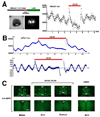
To address the role of
MAPK in regulating circadian rhythms, we generated transgenic mice
carrying an hBmal1-luciferase construct to measure clock-gene
activity in real time in the SCN (,
left). We prepared SCN slice cultures, and measured the bioluminescence
with a photomultiplier tube. We successfully confirmed circadian
transcription of Bmal1 over a period of 1–2 weeks. Next, to
examine the role of MAPK in circadian gene expression in the SCN, SCN
slice cultures were treated for 2 d with
1,4-diamino-2,3-dicyano-1,4-bis( o-aminophenylmercapto) butadiene
(U0126), a specific inhibitor of the MAPK direct activator ERK kinase
(MEK) (,
right). We confirmed previously that U0126 does not affect luciferase
enzyme activity or light emission (data not shown). The pharmacological
inactivation of MAPK significantly dampened the rhythms and reduced the
basal levels of circadian transcription of Bmal1. The detrended
data showed that the amplitude was reduced to ~40% ( supplemental Fig. 1, available at http://www.pubmedcentral.nih.gov/redirect3.cgi?&&auth=0RA0oSwop1cT4h3AnFnvRIwTesIp6j7tkHZ3J2kSI&reftype=extlink&article-id=2440636&issue-id=168205&journal-id=319&FROM=Article%7CBody&TO=External%7CLink%7CURI&rendering-type=normal&&http://www.jneurosci.org
as supplemental material). Treatment with the solvent DMSO did not have a
significant effect. After washout of U0126, the SCN explants recovered a
robust circadian gene expression, demonstrating that these effects were
not the result of toxicity. This reversibility also indicates that the
rhythm-generating potential in the SCN is preserved even in the presence
of U0126.
|
Figure
1
The effect of MAPK
inhibition on circadian clock gene expression in the SCN.
A, Left, Diagram of the
hBmal1-luc transgene construct, and a brightfield and
bioluminescence image of the SCN from an hBmal1-luc
transgenic mouse. OC, Optic chiasma; ROREs,
(more ...) |
The transcription of
Bmal1 is positively and negatively regulated by the nuclear
orphan receptors retinoid-related orphan receptor α(RORα) and REV-ERBα,
respectively ( Preitner et al., 2002). To examine whether MAPK inhibition
affects clock genes whose transcription is regulated by a different
mechanism, similar experiments were performed using SCN slice cultures
prepared from Period1-luciferase transgenic rats ( Yamazaki et al., 2000) ().
The expression of Period ( Per) genes is driven by the
CLOCK [neuronal PAS domain protein 2 (NPAS2)]/BMAL1 transcription complex,
and PER proteins, together with Cryptochrome, feed back to negatively
regulate the CLOCK (NPAS2)/BMAL1 transcription complex ( Ko and Takahashi, 2006). As in the case of Bmal1
transcription, the inactivation of MAPK dampened the rhythms and reduced
the basal levels in the circadian transcription of Per1. Similar
results were also obtained with Per2-luciferase knock-in mice ().
The washout of U0126 reinstated the robust circadian transcription of both
Per1 and Per2.
|
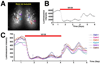
Figure
2
The role of MAPK in
individual SCN cellular clocks. A, A
bioluminescence image of the SCN from a Per2-luciferase
knock-in mouse. Square boxes indicate single SCN neurons whose
bioluminescence was monitored. B, The
total luminescence intensity of the SCN
(more ...) |
In addition, we were able to
immunohistochemically detect active MAPK in the ex vivo SCN slice
().
However, active MAPK immunoreactivity was almost undetectable in the
presence of U0126 and, importantly, the MAPK activity was restored by the
removal of the drug, consistent with the restoration of circadian gene
expression observed in ,
and .
Together, these data suggest that MAPK is autonomously activated in an
ex vivo SCN slice, where it is involved in the maintenance of a
robust circadian gene expression. The MAPK activity in the rat SCN
oscillates with a similar phase as that in mice ( Guillaumond et al., 2007), and, therefore, we used the rat
SCN for a higher frequency of similar slice surfaces. However, we could
not exclude the possibility that MAPK plays different roles between these
species, because MAPK activity shows a different anatomical distribution
between the mouse and rat SCN. Future studies are required to determine
the species difference in the MAPK role. We were also unable to
conclusively determine whether levels of activated MAPK showed circadian
fluctuations in the ex vivo SCN slice immunohistochemically, as
it was difficult to quantify the signal intensity because of the explant
thickness (400 µm) and variable slice surface. Previous reports have
demonstrated that two rhythmic regions of phospho-p44/42 MAPK (pMAPK)
immunoreactivity are observed in the hamster and mouse SCN: a shell-like
pattern with peak expression during subjective day and a core-like pattern
present during subjective night ( Obrietan et al., 1998; Lee et al., 2003). Unfortunately, we cannot discuss the
detailed anatomical distribution of pMAPK in experiments using cultured
SCN slices because of faint images and ambiguous slice surfaces Counting the total luciferase
activity from the cultured SCN does not allow us to determine what happens
to individual cellular clocks. To examine the effects of MAPK inactivation
on circadian gene expression in individual neurons, we performed a
single-cell bioluminescence imaging of an ex vivo SCN slice
prepared from Per2-luciferase knock-in mice ( Yoo et al., 2004) ().
By using knock-in mice expressing PER2-LUC fusion protein from the
endogenous Per2 genomic locus, we can exclude indirect or
secondary effects on transgene transcription caused by the genomic
location, incomplete promoter/enhancer activation, or transgene copy
number (these can all be potential problems in the case of transgenic
mice). Therefore, the luciferase activity from the
Per2-luciferase knock-in mice will accurately reflect the
endogenous transcriptional regulation of Per2. The
bioluminescence was measured in real-time in several individual cells with
a highly sensitive cryogenic CCD camera (LV200; Olympus). The cultured SCN
neurons were treated with U0126 for 2 d, after which the U0126 was washed
away ().
represents
the total bioluminescence from SCN cultures. The specific inhibition of
the MAPK activity resulted in an immediate and drastic decrease of the
basal PER2-LUC expression in individual neurons ( supplemental Fig. 2, available at http://www.pubmedcentral.nih.gov/redirect3.cgi?&&auth=0JUc-ktHoEh2nUxj0ABuDBvUd0flif2jY9HDa9AvZ&reftype=extlink&article-id=2440636&issue-id=168205&journal-id=319&FROM=Article%7CBody&TO=External%7CLink%7CURI&rendering-type=normal&&http://www.jneurosci.org
as supplemental material). The circadian oscillation of PER2-LUC
expression was not completely abolished, but was significantly dampened.
Treatment with the solvent DMSO did not have a significant effect. After
washout of the U0126, the basal expression levels and oscillation
amplitude of PER2-LUC were gradually restored, as observed in the
hBmal1-luc transgenic mice in .
Although slight variations in the extent to which the basal levels and
oscillation amplitude of Per2 transcription decreased was
observed among the individual cells, all of the cells measured in this
experiment showed a similar disturbance in the circadian oscillation of
the Per2 expression in response to U0126. There are two possible
interpretations of these observations: one is that the activity of MAPK is
involved in circadian gene expression in every SCN neuron, and the other
is that MAPK plays a role in circadian gene expression in a specific
subset of SCN neurons and the effects derived from the inactivation of
MAPK in these neurons spread over the entire SCN through intercellular
communication. According to previous reports, MAPK is an intracellular
mediator of both the VIP (vasoactive intestinal polypeptide) and AVP
(arginine vasopressin) signaling ( Arima et al., 2002; Hughes et al., 2004), implying another possibility that the
effects of MAPK inhibition on Per2 transcription result from
disruption of the intercellular communication among SCN neurons. In each
experiment, we monitored >15 signals, in addition to the six cells
shown which are easily and reliably distinguishable as a single cell.
However, we still could not conclude that MAPK activity is required for
Per2 circadian transcription in all the individual SCN
neurons. SCN neuronal activity
exhibits autonomous circadian rhythms, which are thought to play an
indispensable role in the synchronization of individual SCN cellular
clocks and the generation of behavioral and physiological output rhythms.
Moreover, a previous study suggests that the SCN firing rhythms contribute
to the maintenance of the robust circadian expression of the clock genes
in the SCN ( Yamaguchi et al., 2003). However, the molecular mechanism by
which circadian firing rhythms interact with circadian clock gene
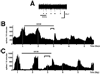
expression remains undefined. We investigated whether inactivation of MAPK
affects the rhythm of SCN neuronal activity. An SCN slice was cultured on
a multiple-electrode array, and multiunit activity was continuously
recorded. The neuronal firing signals were extracted from the raw voltage
traces by using Spike Detector software (),
and the number of spikes was counted every 10 min (,
each representing an individual experiment). Before the addition of U0126,
the firing activity showed a circadian pattern as reported previously ( Welsh et al., 1995). The detrended data unmasked the
circadian peaks of the SCN neuronal activity ( supplemental Fig. 3A,B, available at http://www.pubmedcentral.nih.gov/redirect3.cgi?&&auth=0BKehI-8r99jgu_FbHSZhrxr7qi1CIm1cifSOPAcR&reftype=extlink&article-id=2440636&issue-id=168205&journal-id=319&FROM=Article%7CBody&TO=External%7CLink%7CURI&rendering-type=normal&&http://www.jneurosci.org
as supplemental material). The day 2 peak was hardly affected by the U0126
addition, whereas the subsequent peak (day 3) was almost completely
abolished, at least during the U0126 treatment ( supplemental Fig. 3C, available at http://www.pubmedcentral.nih.gov/redirect3.cgi?&&auth=0dex0c_JSS2HSL8TYvEtqj5tppZggmxwXKy1-VA1N&reftype=extlink&article-id=2440636&issue-id=168205&journal-id=319&FROM=Article%7CBody&TO=External%7CLink%7CURI&rendering-type=normal&&http://www.jneurosci.org
as supplemental material). Although a transient firing surge just after
the removal of U0126 was thought to be a temporary response induced by
sample handling, we still cannot exclude the possibility that it may be
the day 3 peak, phase-delayed by U0126. Treatment with the solvent DMSO
did not have a significant effect. This slow response of firing activity
to MAPK inhibition is significantly different from the relatively rapid
response of clock gene expression to MAPK inhibition observed in and
.
One possible interpretation of this data are that the MAPK signaling
cascade may be both a downstream target of the neuronal discharge and an
upstream mediator of clock gene expression. Therefore, MAPK inhibition
initially disturbs the circadian clock gene expression, and after a time
lag, this disturbance is reflected as the severe abolishment of the firing
rhythms. The removal of the drug from the SCN slice cultures restored the
robust rhythmic firing, albeit with a different phase from the original
rhythm, as observed for circadian clock gene expression (,
).
However, the restoration of the rhythmic firing by removal of the drug was
not infrequently undetectable. Unfortunately, we could not distinguish
whether this was because cultured tissues were broken off from the
electrodes by sample handling such as pipetting, or because the rhythmic
firing was irreversibly abolished by U0126. There appears to be some
degree of variation among individual neurons or mice in the effect of
U0126 on firing rhythms, suggesting that the sensitivity of individual SCN
neurons to the MEK inhibitor may be not homogeneous. For example, the day
2 peak of firing rhythms in was
not affected by the presence of U0126, whereas the corresponding peak in
was
severely phase-shifted. Together, these data demonstrate that MAPK
activity plays a pivotal role in the suprachiasmatic firing rhythms, as
well as in the circadian clock gene expression.
|
Figure
3
Involvement of MAPK
in suprachiasmatic firing rhythms. A,
Representative data of raw voltage traces are shown. Triangles
indicate discriminated spikes. B, C,
Firing rhythms were expressed in histograms of the number of spikes
every 10 min. U0126 (20 µ
(more ...) |
|
In several other
organisms, the circadian fluctuation of the MAPK activity in the circadian
pacemaker is involved in circadian input pathways ( Cermakian et al., 2002) or behavioral/physiological outputs
( Sanada et al., 2000; Ko et al., 2001; Williams et al., 2001), but there have been no reports
indicating that MAPK functions as a core clock component. Our results
demonstrate that activated MAPK is significantly detectable in an ex
vivo SCN slice (morphological differences among species remain
undefined), and suggest an essential role for MAPK activity in the
maintenance of robust circadian clock gene expression in individual
neurons. We also found that MAPK is involved in regulating the robustness
of suprachiasmatic firing rhythms. Although several studies have reported
that regional differences in MAPK activity rhythms are observed ( Obrietan et al., 1998; Lee et al., 2003), our single-cell imaging studies imply that
SCN neurons located in any compartment may require MAPK activity for
robust circadian rhythms. Thus, these results strongly suggest that MAPK
is a functional component in the SCN autonomous circadian system.
Light-induced discharges in the SCN neurons may activate MAPK ( Obrietan et al., 1999; Tischkau et al., 2000), thus implying the possibility that
light-independent circadian discharges also function as upstream signals
to activate MAPK in a circadian manner. The cAMP response element binding
protein (CREB) is generally believed to be one of the downstream targets
of activated MAPK in the SCN ( Obrietan et al., 1999; Coogan and Piggins, 2004), and activated CREB may drive
circadian transcription of clock genes such as Per1 ( Travnickova-Bendova et al., 2002). Both neuronal activity
rhythms and circadian clock gene expression have been thought to be
necessary for well synchronized and robust autonomous circadian rhythms in
the SCN, and one possible interpretation is that these two components of
the SCN autonomous circadian system are functionally interconnected via
the MAPK signaling cascade. |
|
|
This work was supported by
fellowships from the Japan Society for the Promotion of Science and
National Institutes of Health Grant NS051278 (S.Y.). We thank Hajime Tei,
Rika Numano, Mamoru Nagano, Yoko Hatta-Ohashi, Masayuki Ikeda, and Wataru
Nakamura for technical advice; Hitomi Maeyama, Rie Ichiyama, Yuko Tsuboi,
and Asuka Tsugitomi for their expert technical assistance; and Sato Honma
for help and discussions. Per2-luciferase knock-in mice were
kindly provided by Joseph Takahashi. We express our great appreciation to
Tetsuaki Hirase, Teruo Inoue, and Yasufumi Shigeyoshi for general
support. |
|
References
-
Arima H, House SB, Gainer H, Aguilera G. Neuronal
activity is required for the circadian rhythm of vasopressin gene
transcription in the suprachiasmatic nucleus in vitro. Endocrinology. 2002;143:4165–4171. [PubMed] -
Cermakian N, Pando MP, Thompson CL, Pinchak AB,
Selby CP, Gutierrez L, Wells DE, Cahill GM, Sancar A, Sassone-Corsi P.
Light induction of a vertebrate clock gene involves signaling through
blue-light receptors and MAP kinases. Curr
Biol. 2002;12:844–848. [PubMed] -
Coogan AN, Piggins HD. MAP kinases in the mammalian
circadian system—key regulators of clock function. J Neurochem. 2004;90:769–775. [PubMed] -
Dunlap JC. Molecular bases for circadian clocks.
Cell. 1999;96:271–290. [PubMed] -
Guillaumond F, Becquet D, Blanchard MP, Attia J,
Moreno M, Bosler O, Francois-Bellan AM. Nocturnal expression of
phosphorylated-ERK1/2 in gastrin-releasing peptide neurons of the rat
suprachiasmatic nucleus. J Neurochem.
2007;101:1224–1235. [PubMed] -
Hughes AT, Fahey B, Cutler DJ, Coogan AN, Piggins
HD. Aberrant gating of photic input to the suprachiasmatic circadian
pacemaker of mice lacking the VPAC2 receptor. J Neurosci. 2004;24:3522–3526. [PubMed] -
Ko CH, Takahashi JS. Molecular components of the
mammalian circadian clock. Hum Mol Genet.
2006;15:R271–R277. [PubMed] -
Ko GY, Ko ML, Dryer SE. Circadian regulation of
cGMP-gated cationic channels of chick retinal cones. Erk MAP Kinase and
Ca 2+/calmodulin-dependent protein kinase II. Neuron. 2001;29:255–266. [PubMed] -
Lee HS, Nelms JL, Nguyen M, Silver R, Lehman MN. The
eye is necessary for a circadian rhythm in the suprachiasmatic nucleus.
Nat Neurosci. 2003;6:111–112. [PubMed] -
Obrietan K, Impey S, Storm DR. Light and circadian
rhythmicity regulate MAP kinase activation in the suprachiasmatic
nuclei. Nat Neurosci. 1998;1:693–700. [PubMed] -
Obrietan K, Impey S, Smith D, Athos J, Storm DR.
Circadian regulation of cAMP response element-mediated gene expression
in the suprachiasmatic nuclei. J Biol
Chem. 1999;274:17748–17756.
[PubMed] -
Preitner N, Damiola F, Lopez-Molina L, Zakany J,
Duboule D, Albrecht U, Schibler U. The orphan nuclear receptor
REV-ERBalpha controls circadian transcription within the positive limb
of the mammalian circadian oscillator. Cell. 2002;110:251–260. [PubMed] -
Reppert SM, Weaver DR. Coordination of circadian
timing in mammals. Nature.
2002;418:935–941. [PubMed] -
Sanada K, Hayashi Y, Harada Y, Okano T, Fukada Y.
Role of circadian activation of mitogen-activated protein kinase in
chick pineal clock oscillation. J
Neurosci. 2000;20:986–991.
[PubMed] -
Schibler U, Sassone-Corsi P. A web of circadian
pacemakers. Cell. 2002;111:919–922. [PubMed] -
Tischkau SA, Gallman EA, Buchanan GF, Gillette MU.
Differential cAMP gating of glutamatergic signaling regulates long-term
state changes in the suprachiasmatic circadian clock. J Neurosci. 2000;20:7830–7837. [PubMed] -
Travnickova-Bendova Z, Cermakian N, Reppert SM,
Sassone-Corsi P. Bimodal regulation of mPeriod promoters by
CREB-dependent signaling and CLOCK/BMAL1 activity. Proc Natl Acad Sci USA. 2002;99:7728–7733. [PubMed] -
Wang GK, Sehgal A. Signaling components that drive
circadian rhythms. Curr Opin Neurobiol.
2002;12:331–338. [PubMed] -
Welsh DK, Logothetis DE, Meister M, Reppert SM.
Individual neurons dissociated from rat suprachiasmatic nucleus express
independently phased circadian firing rhythms. Neuron. 1995;14:697–706. [PubMed] -
Williams JA, Su HS, Bernards A, Field J, Sehgal A. A
circadian output in Drosophila mediated by neurofibromatosis-1
and Ras/MAPK. Science. 2001;293:2251–2256. [PubMed] -
Yamaguchi S, Isejima H, Matsuo T, Okura R, Yagita K,
Kobayashi M, Okamura H. Synchronization of cellular clocks in the
suprachiasmatic nucleus. Science.
2003;302:1408–1412. [PubMed] -
Yamazaki S, Numano R, Abe M, Hida A, Takahashi R,
Ueda M, Block GD, Sakaki Y, Menaker M, Tei H. Resetting central and
peripheral circadian oscillators in transgenic rats. Science. 2000;288:682–685. [PubMed] -
Yoo SH, Yamazaki S, Lowrey PL, Shimomura K, Ko CH,
Buhr ED, Siepka SM, Hong HK, Oh WJ, Yoo OJ, Menaker M, Takahashi JS.
PERIOD2::LUCIFERASE real-time reporting of circadian dynamics reveals
persistent circadian oscillations in mouse peripheral tissues.
Proc Natl Acad Sci USA. 2004;101:5339–5346. [PubMed] -
Young MW, Kay SA. Time zones: a comparative genetics
of circadian clocks. Nat Rev Genet.
2001;2:702–715. [PubMed] |
|
|



 The publisher's final edited version of this article is available free at