Brain Physiology, Cognition and Consciousness group: topic
This is a public discussion board
What´s the Real Role of Inhibition?
Alfredo Pereira Jr
Sunday, 06 January 2008 12:01 UTC
Dear All:
I have been puzzled about the role of inhibition in the brain. For instance,
the inhibition of pain is part of the mechanisms that produces pleasure.
However, pleasure is more than the absence of pain. Do inhibitory mechanisms
also generate the very sensation of pleasure? Or is it dependent on excitatory
mechanisms?
Below I reproduce a part of my post to the NN Forum that
discusses the Ethics of Cognition-Enhancing Drugs. I wellcome comments that help
me to reduce my ignorance on this subject!
“Reducing inhibitory activity (e.g. inhibiting GABAergic inhibitory transmission) is not the same as increasing excitatory activity (e.g. increasing glutamatergic transmission), but in practice the effects may look the same. Normal brain functionning depends on a balance of excitation and inhibition, but the effects of inhibition are still not well understood. Is inhibition just conterbalancing excitation, or does it also have a constructive role? How does inhibition impact on the EEG and BOLD fMRI? These techniques do not identify the contribution of excitatory and inhibitory activity to the generation of (respectively) electric fields (EEG) or hemodynamic responses (fMRI). Until there is a better understanding of inhibition, and the roles of the balance of excitation and inhibition, it is difficult to predict the long-lasting effect of drugs that interfere with these processes”.
Best Regards,
Alfredo
-
tags
-
all tags
- No tags for this topic.
-
-
Replies
Jump to resultsResults
-
Dear Alfredo,
I think no scientist in these days can give a certain answer to the question what “inhibition does”.
To comment shortly on “pleasure is more than the absence of pain” with a rather unscientific statement I would like to cite Arthur Schopenhauer, a german philosopher: “Das Gefühl des Glücks ist nur die Abwesenheit eines Wünsches” (~ pleasure is only the abscence of a certain wish through its satisfaction).“Reducing inhibitory activity (e.g. inhibiting GABAergic inhibitory transmission) is not the same as increasing excitatory activity (e.g. increasing glutamatergic transmission), but in practice the effects may look the same."
So inhibiting the inhibitor should result in a general increase in excitability, therefore, at least to some extent, it is the same. But I think no one that investigates inhibtion would be satisfied with the notion that inhibiton just regulates excitability! There are a lot of nice examples (also recently) that illustrate the potential computational implications of interneuron firing (Larkum and Sakmann in Nature, Houwling and Brecht in Nature). Although one may state that for some interneurons it is really their main function to “protect” pyramidal cells from overexcitation (e.g. Silberberg and Markram) I would also state that this is a computational mechanism in the sense that the neuronal signals conveyed are not disrupted by unlinked information.
A nice paper that may be potentially intersting comes from Wulff and Wisden in Nature Neuroscience. The possiblity of manipulation will shed a lot of light onto inhibitory mechansims and there contribution to network activity.Kind regards,
Mike -
Dear Mike:
Many many thanks for your message!
The Wulff et al. paper (Abstract and link to free full text below) really introduces a technique that may be scientifically revolutionary. I can´t wait to see what will occur when apply it to other parts of the brain more related to consciousness (the paper reports an experiment with Purkinje cells at the celebellum causing “significant motor deficits”).
From this first demonstration it seems to me that soon they will gather more data that will tell us something about the role of inhibitory activity for consciousness.
Best Regards,
Alfredo
Nat Neurosci. 2007 Jul;10(7):923-9. Epub 2007 Jun 17.
Free author manuscript at PubMed Central
From synapse to behavior: rapid modulation of defined neuronal types with
engineered GABAA receptors.Wulff P, Goetz T, Leppä E, Linden AM, Renzi M, Swinny JD, Vekovischeva OY,
Sieghart W, Somogyi P, Korpi ER, Farrant M, Wisden W.Department of Clinical Neurobiology, University of Heidelberg, Im Neuenheimer
Feld 364, 69120 Heidelberg, Germany. p.wulff@abdn.ac.ukIn mammals, identifying the contribution of specific neurons or networks to
behavior is a key challenge. Here we describe an approach that facilitates this
process by enabling the rapid modulation of synaptic inhibition in defined cell
populations. Binding of zolpidem, a systemically active allosteric modulator that
enhances the function of the GABAA receptor, requires a phenylalanine residue
(Phe77) in the gamma2 subunit. Mice in which this residue is changed to
isoleucine are insensitive to zolpidem. By Cre recombinase-induced swapping of
the gamma2 subunit (that is, exchanging Ile77 for Phe77), zolpidem sensitivity
can be restored to GABAA receptors in chosen cell types. We demonstrate the power
of this method in the cerebellum, where zolpidem rapidly induces significant
motor deficits when Purkinje cells are made uniquely sensitive to its action.
This combined molecular and pharmacological technique has demonstrable advantages
over targeted cell ablation and will be invaluable for investigating many
neuronal circuits.PMID: 17572671 [PubMed – indexed for MEDLINE]
-
Dear Alfredo,
I think the link to consciousness is a big leap.
Are you aware of testing consciousness or awareness in mice or rats? This would be of great interst to me…
I mean, I could certainly think of a lot of things that can be done with this technique but until it is applicable to studies testing perception and so on, I think it will take some time.
For example if it would be possible in cortex (e.g. barrel cortex) this would shed some new light. other possiblities are offered be the technique of deisseroth in the future, but even there I don’t know how the scientific field in this area would react to links to consciousness… -
Dear Mike:
The link to consciousness is not so complicated as you might think. For instance, one of the areas where the balance of excitation and inhibition is discussed is generalized epilepsia. In the case of absence epilepsy (‘petit mal’) the main simptom is an abrupt loss of consciousness, without convulsive behavior.
It can begin with a failure of GABAergic inhibition in the thalamus (this alternative is often used in experimental models using drugs that impair GABAergic transmission), or with an excess of excitation in the cortex. As there are many thalamo-cortical and cortico-thalamic connections, no matter the origin the result is the same: a “spike wave” that is experimentally correlated with the loss of consciousness and excessive calcium entry in neurons.
I agree that the neuroscientific research community is not well trained to relate their findings with the problem of consciousness. For instance, a researcher who works with CaMKII knocked out mice presented a poster in a conference reporting the behavioral impairments of the animal. I asked her about effects on consciousness, and only at this moment she realized that such effects were severe: the animals did not respond to auditory stimulation, episodic memory was not formed, spatial orientation was poor, etc.Best Regards,
Alfredo
-
Returning to the original question, inhibition seems to play little to no role in either EEG or LFP readings in the brain. On the contrary, there is some evidence for inhibition contributing to BOLD signals (check here, here and here).
As for the role of inhibition, there are many! People looking at circuits often demonstrate that inhibition can shape the signal-to-noise ratio as different brain areas pass information; inhibition can prevent a pyramidal cell from spiking at the axon hillock; it also integrates with all excitatory input at the level of the dendrites and soma, adding another aspect of “gain” for individual neuron signaling.
I won’t touch on its role in consciousness because I feel that it is too difficult to not intertwine all neuromodulation and signaling in that discussion, since the “total transmission balance” is likely to be more relevant to the state of mind (whatever that means…). But, I will say that it is extremely interesting that inhibition and inhibitory neurons evolved much later than the more primitive glutamatergic transmission.
-
Dear Noah:
Many thanks for your clarifications and links.
I will make some comments on your text:NG: “Returning to the original question, inhibition seems to play little to no role in either EEG or LFP readings in the brain.”
APJ: Why not? Please consider that inhibitory activity includes the excitation of inhibitory (inter)neurons, the action of these neurons on excitatory ones, and eventually the hyperpolarization of the latter ones. All these activities involve the movement of ions, which generate bioelectric activity (generation of dipoles) detected by scalp electrodes. Physically, a process of hyperpolarization seems to generate a stronger electric field than the process of depolarization, which generates a discharge as soon as the membrane (dendritic and soma) potentials reach a threshold.
NG: “On the contrary, there is some evidence for inhibition contributing to BOLD signals…”
APJ: N. Logothetis and colleagues have shown that the BOLD signal correlates with LFPs.
NG: “As for the role of inhibition, there are many! People looking at circuits often demonstrate that inhibition can shape the signal-to-noise ratio as different brain areas pass information; inhibition can prevent a pyramidal cell from spiking at the axon hillock; it also integrates with all excitatory input at the level of the dendrites and soma, adding another aspect of “gain” for individual neuron signaling.
I won’t touch on its role in consciousness because I feel that it is too difficult to not intertwine all neuromodulation and signaling in that discussion, since the “total transmission balance” is likely to be more relevant to the state of mind (whatever that means…). But, I will say that it is extremely interesting that inhibition and inhibitory neurons evolved much later than the more primitive glutamatergic transmission.”APJ: My question was precisely about the role of inhibition for consciousness. If inhibition does not have a proper role for consciousness (e.g. in producing sensations of pleasure), it surely has a role in the generation of the total balance. And then the question is: why consciousness only exists in the range of balanced activity? Consciousness is lost with too much excitation (e.g. absence epilepsy) and too much inhibition (e.g. anesthetic effects of benzodiazepinic drugs).
Best Regards,
Alfredo
-
NG: “Returning to the original question, inhibition seems to play little to no role in either EEG or LFP readings in the brain.
RB: At first glance that may seem to be true. But look at the average evoked related potential from babies brains to the stimulus ba ba ba ba GA ??
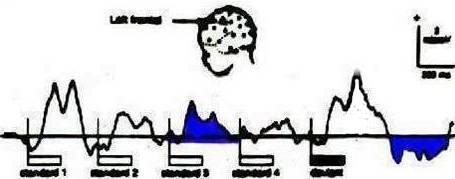
The average of the four bas is the third ba. Notice that inhibition or habituation only reduces the response to a particular stimulus. The Next to the last wave marked in blue is the average wave created by the stimulus GA. The last wave marked in blue is an unknown response which is simular to the average ba inverted.
-
I guess I spoke a little too generally. To clarify, inhibition definitely shapes the LFP response (amplitude, etc…), but meant to say that rarely contributes to an evoked response.
Alfredo, I linked those papers for precisely the reason that you state; namely that BOLD and LFP usually do correlate, however, it is theoretically possible to see changes in BOLD signals without a concomitant change in LFPs, possibly due to the activity of interneurons (which would contribute to the BOLD, but perhaps not cause detectable changes to an evoked LFP).
-
Dear Ronald:
RB:“Notice that inhibition or habituation only reduces the response to a particular stimulus.”
Alfredo: It (obviously) reduces spiking activity, but on the contrary it increases the magnitude of membrane electric fields. These fields are part of what is technically called “Local Field Potentials”. Depending on out theoretical goals, it is possible to consider the LFP – and not spiking activity – as the relevant response to a stimulus.
RB:“The Next to the last wave marked in blue is the average wave created by the stimulus GA. The last wave marked in blue is an unknown response which is simular to the average ba inverted.”
Alfredo: Considering that an inversion of sign may mean an inversion of direction of the current relatively to the position of the electrode, the last blue wave could be recurrent signaling from (inter)neurons that received the first wave (i.e. spike train). In this case the first five waves would corespond to excitatory activity (modulated by inhibitory interneurons) in the measured location, and only the last (sixth, blue) wave would correspond to properly inhibitory input. A very complex issue!
Best
Alfredo
-
Dear Noah:
You wrote: “inhibition definitely shapes the LFP response (amplitude, etc…), but meant to say that rarely contributes to an evoked response”.
Alfredo: I agree if the evoked response is defined in terms of action potentials. In this case, single cell measurement (with the electrode placed at the neuron’s axon hillock) could detect the response reliably. If the evoked response is measured with scalp eletrodes (as in ERP studies), I cannot agree because these electrodes do not discriminate between biologically different electric activities, they capture all kinds of membrane activity besides action potentials.
[OBS.: You possibly know these technical details better than me, but some readers may find the above remarks helpful]NG: “…it is theoretically possible to see changes in BOLD signals without a concomitant change in LFPs, possibly due to the activity of interneurons (which would contribute to the BOLD, but perhaps not cause detectable changes to an evoked LFP).”
Alfredo: I have my doubts about this possibility. The papers you indicated support a correlation between inhibitory activity and hemodynamic response, but they tell nothing about the relation of inhibitory activity and LFPs. The first one, by Lauritzen, shows that there is no correlation between the hemodynamic response and “the spike rate of the same region”/“the output level of activity of a region”.
However, spiking activity is not a component of LFPs! According to Logothetis, LFPs are defined as the sum of all slow synaptic activities in a brain region. Therefore, LFPs correlate positively with the amount of spikes arriving at the synapses, not with the spikes generated by the synaptic activity and transmitted along the axons of the neurons (these spikes correspond to Lauritzen’s "output activity).Many thanks for your collaboration with this discussion. The issue is very complex and I am probably still making my mistakes!
Best
Alfredo
Results
-


