This work was made possible in part by Grants 410-93-1127 and 410-96-0681 (to Roth) from the Social Sciences and Humanities Research Council of Canada and Travel Grants (to Welzel) by the Deutsche Forschungs Gemeinschaft (We 2167/3-1) and by the University of Bremen (FNK 01/823/4).
All correspondence concerning this paper should be addressed to Manuela
Welzel, Institute of Physics Education, Universität Bremen, PF 330 440, 28334
Bremen, Germany. E-mail: mwelzel@physik.uni-bremen.de
Tel: (+49)
421-218-2130
Fax: (+49) 421-218-4015
Interviews are important assessment means. Most studies assume that interviews can be used to assess conceptual framework relatively stable in the interview situation. We provide evidence here that questions this assumption. Using a situated cognition framework, we reanalysed pre-test and post-test interviews from large classroom study. Our analyses show that cognition, rather than being a stable property of individuals, is a dynamic process which changes in different ways over shorter and longer time scales. We also observed considerable interactions between the complexity of the questions asked by the interviewer and the complexity of cognitive processes that interviewees enacted. Finally, our analysis reveals moments of breakdown when interviewers' and interviewees' expectations of the situation were mismatched. Implications are drawn for organising interviews intended to elicit information about cognition.
1. Introduction
Assessment plays an important part in science education research and teaching. Current assessment practices are based on a wide range of techniques, but, especially for research purposes, interviews are often considered among the most reliable ways for determining what a person knows (Champagne, Gunstone, & Klopfer 1985; Wandersee, Mintzes, & Novak 1994). Using interviews, researchers attempt to find out what students know about a specific context (conceptual and procedural knowledge) before and after instruction to show if and how the learning processes or the designed teaching strategy were successful. Depending on their theoretical backgrounds, authors make varying recommendations how interviews should be structured and conducted to assess this knowledge (or problem solving processes) in the most reliable way (Collins, Hawkins, & Frederiksen 1994; Ely 1991; Powney & Watts 1987). Most research on conceptual understanding and problem solving uses interviews with the underlying assumptions that knowledge (or problem solving skills) exist in the form of stable structures and processes(e.g., Champagne et al. 1985; Reif & Heller 1982).
In recent years, traditional assumptions of knowledge assessment and interview processes have been challenged: knowledge and interview processes are said to include important dynamic components that shape the data researchers will generate (Magnusson, Templin, & Boyle 1997; Smagorinsky 1995; Suchman & Jordan 1990). Thus, any interview, "no matter how standardised remains fundamentally a linguistic and interactional event. Word choice will never eliminate the need for interviewers and respondents to negotiate the meaning of both questions and answers" (Suchman & Jordan 1990, p. 240). Furthermore, interviews play a mediational role which allows interviewer and interviewee to engage a developmental process (Magnusson et al. 1997; Smagorinsky 1995). Knowledge therefore is considered to be a dynamic zone in that interviewees will perform somewhere in their zone of proximal development, the region between solo performance and maximally reachable performance under guidance. Finally, there is also evidence that students' performance is mediated by the interplay of multiple aspects of the assessment situation including the interaction between peers and with the nature of the taskóe.g., word problems versus practical problems (McGinn & Roth 1997).
The present study contributes to the existing literature by providing evidence not only for the dynamic nature of interviews but also for the dynamic nature of cognition exhibited by the interviewee. To observe this dynamic nature of interviews and cognition, appropriate theoretical and methodological tools are necessary. The purpose of the present study is to provide evidence for the dynamic nature of interviews in terms of the complexity of situated cognition. We sought answers to questions such as, "How does situated cognition develop in time within interviews and across interviews?", "How do interviewer/interviewee interactions affect the development of situated cognition?, and "What are constraints on the development of situated cognition during the interview situation?" We begin by outlining a theoretical framework of situated cognition that allows detailed descriptions of situated cognition and by describing details of the study.
2. A Model of Situated Cognition
To understand the dynamic nature of cognition during the interview process, we take a situated cognition perspective (Clancey 1993; Roth & Duit 1996; Varela 1991; von Aufschnaiter, Fischer and Schwedes 1992; von Aufschnaiter & Welzel 1996; Welzel 1995). This situated cognition framework is agent-centred (phenomenological) and uses "agent-in-the-world" (Agre 1993; Chapman 1991) as the basic unit of analysis. That is, cognition and action emerge as agents-act-in-settings (hyphenation underscores the fundamental irreducibility of cognition). Therefore, not only changes in agents but also changes in their worlds change the cognitive characteristics observed by analysts.
Agent-setting interactions concurrently obtain an inward direction
(perception, interpretation) and an outward direction (verbal, physical action);
that is, perception and action are treated at the same level: In many cases,
they cannot be meaningfully separated (Clancey 1993; Varela 1995). These (inward
and outward) actions emerge as agents bring to bear a variety of
experientially-grounded expectations that motivate inward and outward action.
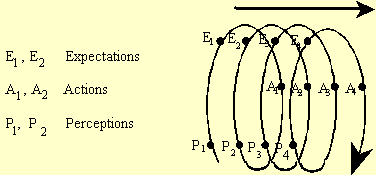
Thus, perception, expectation, and action, as parts of a circular process,
constitute situated cognition. In every new situation, including
interviews, sequences of new meanings are produced to co-ordinate ongoing
perceptions, expectations, and actions (von Aufschnaiter 1992; Fischer & von
Aufschnaiter 1992, 1993; Welzel 1995; von Aufschnaiter & Welzel 1996; Welzel
& von Aufschnaiter 1996, 1997a, 1997b). As Figure 1 shows, situated
cognition, rather than being a stable property of mind, becomes a continuous
process of successive perceptions, expectations, and actions: perception 1 --> expectation 1 --> action 1 --> perception 2 --> expectation
2 --> action 2 --> perception
3 and so on.
This model accounts for the observation that individuals always act in the worlds they perceive and experience (Heidegger 1977). Recent work in cognitive science and artificial intelligence showed that fixed ontologies do not model well human agents in the world and lead to brittle performance in robots (Brooks 1995; Clancey 1993). It is therefore not surprising that physics students perceive physical events in different ways than physicists and physics teachers (Roth 1996; Roth, McRobbie, Lucas, & Boutonné 1997). This flexibility of human agents' ontologies arises because interpretation is inventive. What instructions, plans, objects, tools, or teacher interdictions mean, or what relevant aspects of an object or local setting are, cannot be specified a priori but arises from agents' situated actions.
Because human agents perceive the world differently, their situated actions and ultimately their learning will differ. Several recent AI investigations showed that stability and robustness of everyday knowledge and common sense arises from their embodied nature which is built up as agents interact with their environments (Brooks 1995). More so, intelligent agents are not merely reactive but actively "jig" their environment to achieve maximum cognitive competence (Hammond, Converse, & Grass 1995; Kirsh 1995); cognition includes pragmatic manipulations of the environment that support any associated mental activity.
A series of studies investigating students' activities during lessons about electricity at several age levels from Grade 5 to third year university showed that situated cognition can be categorised in terms of its complexity (Breuer 1995; Welzel 1995; Welzel & von Aufschnaiter 1997a, 1997b). As Table 1 shows, instances during which students perceive and act towards objects (in some holistic way), situated cognition takes place at the level of "object." In the case of lever activities for example, students may initially encounter the lever system as a holistic object. As they work with objects, students focus on details and identify "aspects." Through operations on certain aspects, students begin to identify "properties" and form classes of objects relevant in the context. For example, the objects hanging from a lever have specific weight, fulcrums can be moved, lever beams move up or down, and weights have specific distances to the fulcrum.
| levels | description |
| Systems | Construction of stable networks of variable principles |
| Networks | Systematic variation of a principle according to other principles |
| Connections | Links between several principles with the same or different variable properties |
| Principles | Construction of stable covariations of pairs of properties |
| Programmes | Systematic variation of a property according to other stable properties |
| Events | Links between some stable properties of the same or of different class(es) of objects |
| Properties | Construction of classes of objects on the basis of common or different aspects |
| Operations | Systematic variation of objects according to their aspects |
| Aspects | Links between objects and/or identification of specific features |
| Objects | Construction of stable figure-ground-distinctions |
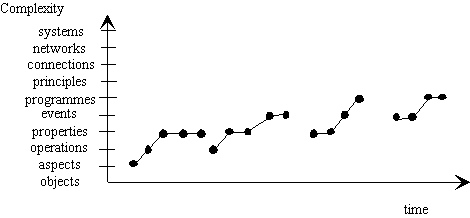
When students' activities are analysed using the categories as a heuristic, one can observe two types of changes in the complexity of their situated cognition (Figure 2). First, on a time scale of seconds to a few minutes, one can observe rapid increases in the complexity of (spoken and material) actions (e.g., Breuer 1995; Welzel 1995; Welzel & von Aufschnaiter 1997a, 1997b). Within a particular lesson, students experience a number of different situations, and each time, increases in the complexity can be observed. Over longer time periods (several lessons), one also observes a drift in the average complexity of the actions, although, as the right part of Figure 2 shows, there are still changes from lower to higher complexity on short time scales. In addition, as students frequency of experience with similar situations increases, one can observe that the bottom-up changes on short time scales become increasingly rapid (e.g., Welzel 1995).
When the described theoretical framework of situated cognition is used to analyse videotaped interviews, new research questions arise regarding the effect of interactions on individual cognitive processes and the assessment of cognition. From the constructivist perspective implicit in our framework, interviews constitute situations in which two agents (the interviewer and the student), both with their individual ontologies and objectives, meet and interact. This study was designed to find answers to the following questions and corresponding hypotheses:
4.1. Database
This study drew on an existing database from a four-month classroom study of Grade 6-7 students' knowing and learning during a unit on simple machines (McGinn & Roth 1997, McGinn, Roth, Boutonné, & Woszczyna 1995; Roth 1996; Roth & McGinn 1996). There were 10 Grade 6 and 16 Grade 7 students.
Prior to and at the end of the unit, students were tested in a number of ways. First, students responded to paper-and-pencil questions about three real-life situations that illustrated applications of levers, pulleys, and inclined planes. Second, interviews were conducted with 13 students about their ideas on simple machines. These interviews were designed to request elaborations of students' written answers and to observe students' qualitative and quantitative responses to Class I lever (balance beam) problems in the presence of actual devices. The post-test was designed in a similar fashion, with the difference that we invited all 26 students to talk as pairs about their answers on the test and to respond to three practical problems related to levers, pulleys, and inclined planes. (The written pre-test and post-test questions relative to levers can be found in the appendix.) In this study, we selected all episodes from the pre-test and post-test interviews with Dave and Jon (pseudonyms), two sixth graders, in the context of lever problems. Because the phenomena reported below are found in the same way in all interviews, we chose to present all data from interaction with the same students.
4.2. Reconstructing Situated Cognition
To reconstruct students' situated cognition selected video sequences are transcribed in great detail including all observable activities (spoken words and sentences, gestures, expressions, and addressees in the communication). This first step of data preparation already includes interpretation and requires considerable experience with classroom context and usual idioms of the participating persons (Fischer 1989; Oevermann, Allert, Konau, & Krambeck 1979). The episode in Table 2 represents one sample transcription. Here, the interviewer (I) asked Jon and Dave to explain their written answers on the post-test.
I (:J) All right, try the next page. (TURNS PAGES) What did you do on this one? Different answers on this one too.
J (:M) Okay, um this is what I did. Well, Laura thought of this. Well she did the load times, load times distance and that's what I did. Like see if you go 6 [DRAWS FINGER ALONG LEFT ARM TO 6 DISTANCE] times 50 [POINTS TO 50 WEIGHT] that's 300, and then you find, and then the other distance [POINTS TO RIGHT ARM DISTANCE] is um you find something [POINTS TO PLACE WHERE WEIGHT SHOULD BE] that goes into 3 to equal 300 [SELF-CORRECTION], and it's 100. so that's how I got my answers. Distance times effort equals 300.
I (:J) And that's what you did for all of them?
J (:M) Yeah.
I (:D) And how about you? What did you put? What did you do Dave?
D (:M) I messed up (laughs)
| No. | Type | "Idea" | Complexity |
| Int: What did you do on this one? aspect | |||
| 1 | v | I have to remember, what I have done, | aspect |
| 2 | v | I took Laura's way. She did load times distance. | operation |
| 3 | v | I did load times distance. | property |
| 4 | v | In this example I did 6 times 50 that's 300. | event |
| 5 | v | And than for the other distance you have to find something that goes into 3 to equal 300. | event |
| 6 | v | This is 100. | event |
| 7 | v | Going these steps I got my answer | event |
| 8 | v | Every time I took distance times something equals 300 | program |
| Int: And that's what you did for all of them? program | |||
| 9 | nvi | That I did for all of the tasks. | program |
5. Results
This study was designed to investigate situated cognition during assessment interviews. Specifically, we were interested in finding answers to questions such as, (a) "What is the dynamic of students' cognitive processes during interviews?" and "Which levels of complexity are reached during interviews?", (b) "How do interviewers' questions and hints influence interviewees' cognitive processes?", and (c) "How do expectations of interviewer and interviewee interact and mediate situated cognition?" Whereas most researchers in science education use interviews as tools for assessing stable states of knowledge, we assumed in this study that interviews constitute social situations in which interviewer and interviewees interact and negotiate meanings. Our study shows:
5.1. Dynamic of Cognitive Development during Pre-test/Post-test Interviews
Contrary to traditional assumptions that interviews elicit data about stable knowledge, this study showed that students' situated cognition developed continuously. Such developments can be observed to occur during each interview and across interviews. To exemplify the dynamic nature of this development during interviews, we provide the following analysis from the pre-test and post-test interviews with Jon, one of the grade 6 students. We begin with a phenomenological description of physics content and students' activities and subsequently analyse in a formal way the complexity of students' situated cognition. (Phenomenological descriptions, first stages in the interpretations, allow readers to reconstruct situations much better than raw transcripts or abstract descriptions [e.g., Roth et al. 1997; Welzel 1995].)
5.1.1. Phenomenological description of the cognition development of Jon
The interviewer began by asking Jon about the paper-and-pencil task related to levers ("Stuck in the Woods," see Appendix). Jon tried to find out what the interviewer wanted to know from him. He focused on the problem with the stuck Jeep and answered that had not been able to answer the question. The interviewer immediately shifted to a new situation. He took a small balanced lever and put several metal nuts as a heavy load on one side of the beam; he proceeded to pick up more metal nuts and hung them from the other side of the lever. While doing this, the interviewer asked Jon where he should hang the second set of metal nuts to make the lever balanced. The student formulated a hypothesis, to put the nuts more to the outside, farther away from the fulcrum ("I would push it out here"). When the interviewer asked Jon to justify his answer, the student pushed the weights farther in than he had initially indicated. Jon wanted to correct the position of the weights, but the interviewer insisted, "How would you know where?" Jon now suggested to put the nuts closer to the fulcrum, because there was more force down on the far end. From previous experiences he knew that it would be easier to balance the lever if the load was close to the fulcrum.
After releasing the beam, the interviewer continued to insist, "Actually it is pulling even more. You want to make it balanced, what would you do now?" But Jon appeared stymied and engages in guessing ("no, not exactly, maybe here"). He did not know what the interviewer wanted to hear and see. To the question how to know how far he has to do it, he said, that he did not know how far to move. The interviewer encouraged Jon to focus on distances. Jon responded that he was judging the distances between the fulcrum and the load and the fulcrum and the nuts on the other side ( "...between here and here and than between there and there.")
In the second part of the interview, the interviewer turned the lever around which allowed Jon (as all other students) to see the distance markers (which appeared only on one side of the beam). Jon now focused on these markers to find their properties relative to the lever and weights the interviewer suspended from the beam. The availability of the markers (numbers) helped Jon to find a first relationship between a specific location and the movement of the lever: "I have to do it on this place (marked with 5), because that would be pulling down."
During this interview, Jon had first experiences with levers. The activities allowed him to become acquainted with several details of this device: there are two sides to this lever, a fulcrum, and metal nuts (acting as weights). He took the interviewerís questions as invitations to operate the lever with the aim to find properties which are important to master the situationódistance and weight and their relationships. But the interview process did not provide him with the opportunity to construct appropriate relationships between these properties. As soon as the marked part of the lever became salient, Jon used it as a resource in constructing further relationships.
5.1.2. Formal Descriptions of Situated Cognition.
Using the methods described earlier, a complexity-time diagram of the same interview situation was constructed (Figure 5). The complexity-time-diagram of this interview shows the dynamic of Jonís cognitive processes: There are longer and shorter series of cognitions and single ideas that increase in complexity. That is, there are repeated bottom-up cognitive processes from lower to higher complexity. This repetition reflects the circular nature of cognition as represented in Figure 1. However, the elements within each series are changing because they are contingent on the context of the currently perceived situation. During the interview on the problem of the jeep stuck in the wood, Jonís activities began at the object level and proceeded until he reached the levels of operations and properties. As our phenomenological description showed, he constructed, differentiated, and changed position and number of metal nuts as properties relevant to balancing the lever.
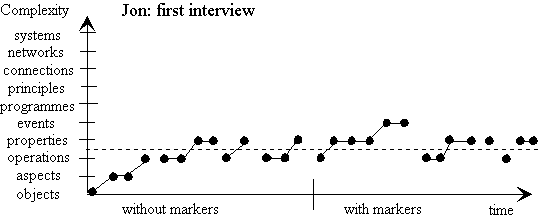
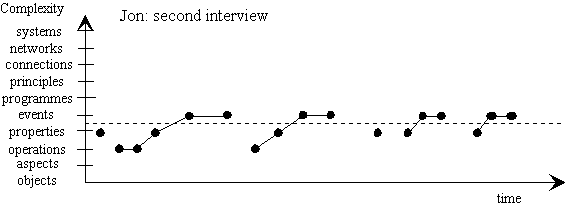
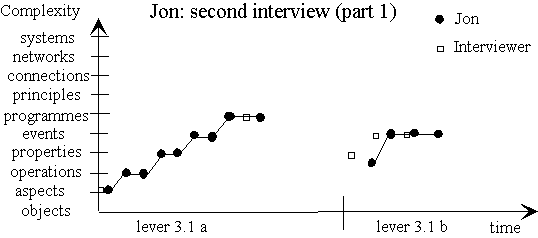
When Figures 3 and 4 are compared, it is evident that the average level of Jonís cognitions during the post-test interview was on a higher level of complexity (between properties and events) than it was during the pre-test interview (between operations and properties) in the same context. He constructed properties such as distance and leverage (though it never became quite clear what he meant by this term) as important elements in the context of the stuck jeep problem and he began to link these properties. To achieve the linkage of properties to form events, he used experiences from the pre-test interview and lessons. Our data show that during each situation with levers, Jonís situated cognition developed. We interpret this shift in average level as an indication of learning.
5.2. Mediating Effects of Questions and Hints on Situated Cognition
In this section, we focus in more detail on the interactional processes between interviewer and interviewee. Our results show that interviewers' questions and hints can guide the interviewee to two types of changes: (a) an increase in the number of elements at one complexity level through differentiation and (b) enaction of processes higher levels of complexity. Interviewees' cognitive systems are enabled to these processes through the scaffolded construction of relationships between the elements of some level. Both changes are represented in complexity-time graphs that plot the complexity of interviewers' and interviewees' actions (Figure 5).
5.2.1. Increase in Number of Elements at One Level
Figure 5 shows that as the interview progressedóguided by the interviewerís questions and hintsóstudents (here Jon) repeatedly enacted cognitions at the level of operations and properties. Repeated enactment of operations or properties allowed interviewees to differentiate their possibilities to act with the materials. For example, the interviewer encouraged students to focus on specific aspects of the lever. In this way, the initially holistic cognition of "lever" changed into one where this lever was an object with specific aspects (having a fulcrum, two arms, weights, etc.). Through the operation of the device (by either agent), affordances of the lever material actions were revealed to the interviewees. Thus, invitations such as "Just push it out there" and "Put it a little bit in" or comments "Oh, you are moving it. Do you know how far?" made specific actions on specific aspects topic of the conversation and therefore brought aspects and operations to the foreground. (Reader will recall that aspects and operations are processes of different complexity in our hierarchy.) On the basis of previous research, we assume that such differentiation is a necessary prerequisite for reaching higher levels of complexity (e.g., Welzel 1995).
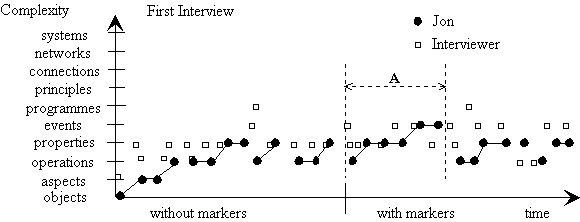
Interviewer questions and hints allowed interviewees not only to
differentiate already attained levels of complexity but also to enact cognition
at the next higher level of complexity. In the following episode (Episode A in
Figure 5), the interviewerís questions afforded a student (Jon) to reach the
event level for the first time (in the context of levers). (Interviewers
questions are followed by the reconstructed "ideas" of students.)
| 01 | I: I have some sort of markers to help us judge the distance. If we took 2 and put it here on 2, where on this side would you put the one to make it balanced? (event, property) |
| 04 | J: For balancing it I would put it here, at 4. (operation) |
| 05 | I: OK, why do you think that? (property) |
| 06 | J: I would put it here, because there are two on the right at the marker two. (property) |
| 08 | I: So you say this is which is 2. (property) |
| 09 | J: There should be two in here, because that's two there (on the other side). (property) |
| 11 | I: That's pretty close. Now if I put one more here, where would that go to make it balanced? (event) |
| 13 | J: If you are putting one more here, than I have to go to balance one more there on the other side at 5. (property) |
| 15 | I: Why do you think it should go here. (event) |
| 16 | J: I have to do it at this place, because that would be pulling down. (event) |
With the following question the interviewerís question was again on the property level (line 08). This allowed Jon to differentiate (in the way discussed earlier) the weights on both sides of the lever. The interviewer posed his subsequent question as if he wanted to "pull" Jon to the event level and released the beam after having placed the weights. However, before moving on to the event level (line 16), Jon stated a hypothesis on the property level (line 13). Another question at the event level which solicited an explicit link between properties (distance, pull, and balance), afforded Jon to reach the next higher level. This linking of properties appeared to have been scaffolded by the specific form of the question, "Why do you think. . .?"
In our first example from the pre-test interviews, most student actions were immediately preceded by an interviewer question (Figure 5). However, the interactions changed after students had many experiences related to levers. As Figure 6 showsóa complexity-time graph of an excerpt from the post-test interview with Jonóstudents could rapidly develop to high levels of complexity on their own and without further interviewer scaffolding. We interpret situations where students quickly reach higher levels of complexity (as in Figure 6) as another indication that learning has occurred (relative to the context of levers).
In our model of situated cognition, expectations are an integral and irreducible part. As Figure 1 showed, expectations drive actions which in turn drive perception in a continuous enactment of situated cognition. It can be expected that differences in expectations will lead to different actions and ultimately perceptions of the interviewer and interviewee. Especially during the pre-test interviews, we found a considerable number of situations in which the expectations of interviewer and interviewee differed. This led to unexpected and often undetected misunderstandings. This is evident in the following episode from the pre-test interview with Jon.
Jon expected that he had to explain his answers related to the jeep problem
and to find out how it could be solved (because he had not been successful). But
the interviewer was primarily interested in soliciting information about Jonís
knowledge of balanced levers. The jeep problem constituted for him only one
application of a special kind of lever. But the situation was different for the
student. The following episode (represented in the form of "ideas") shows, how
distant interviewer and interviewee were. Jon tried to understand the jeep
problem; the interviewer was concerned with the properties of balanced levers.
| 01 | I: Here, you didn't have any answers. (aspect) |
| 02 | J: I could not figure that problem out. (aspect) |
| 03 | I: I take this lever here. I put weights on it like this, so it would be balanced and I have a heavy load like a Jeep. (property) |
| 05 | J: The interviewer is putting a load on one side. (aspect) |
| 06 | I: I put two, three weights on one side and go exactly that way, then I have it here (operation, property) |
| 08 | J: Interviewer is putting two, three nuts on the one side and some others on the other side. (aspect) |
Another situation in which different expectations of interviewer and
interviewee led to an unnoticed breakdown in the communicative process occurred
a little later in the same interview. The interviewer attempted to guide Jon in
finding a general rule on a program level to balance the lever in front of them.
Because Jon did not formulate such a rule, the interviewer encouraged the
student to consider the markers on the beam. But this move was met with little
success as Jon attended to the motion of single weights on the beam.
| 10 | I: Actually it is pulling even more. You want to make it balanced, what would you do now? |
|
| 12 | J: I could try to move the left weights more inwards |
|
| 13 | I: You are moving in, do you know how far? |
|
| 14 | J: I do not know exactly how far to move, may be until here. |
|
| 16 | I: Now it is pulling here more. It is hard to move. It is there anything that could help you to see if you can make it balance |
|
| 18 | J: If it is pulling more, may be I have to go further outward. |
|
The two examples illustrate how expectations at different levels of cognition
lead to situations of (sometimes unrecognised) communicative breakdown. On the
other hand, as the following example shows, if the complexity levels are
compatible, a coherent development of situated cognition can occur. Our example
derives from the post-test interview with Jon (done by a different interviewer).
| 19 | I: Think about your answers again |
|
| 20 | J: I just remembered that load times distance. |
|
| 21 | I: Oh, you remembered Lana's law that we talked about in the class |
|
| 22 | J: Yeah. Because it makes sense because 6 times 50 is 300 so times something has to equal 300, and 3 times 100 is 300, so it would be 100 grams. |
|
| 25 | I: Does that make sense that it would be that much more when it is closer like that. |
|
| 27 | J: I think so. |
|
| 28 | I: Go ahead. |
|
| 29 | J: Well, in a way this is half because half of 6 is 3, and 50, half of 100 is 50. So that makes sense. |
|
6. Discussion
Do interviews really assess students' knowledge? Previous studies in our respective research programs showed that cognition is not a static property of individuals but that cognition is always situated and dynamic. These findings question traditional assumptions about assessment. Particularly, we expected that the assessment of cognition would be contingent on the specifics of each interview situations. This study was therefore designed to answer three sets of questions: "What is the dynamic of students' cognitive processes during interviews?" and "Which levels of complexity are reached during interviews?"; "How do interviewers' questions and hints influence interviewees' cognitive processes?", and "How do expectations of interviewer and interviewee interact and mediate situated cognition?"
In response to the first set of question, our study provided evidence for the development of situated cognition in interview situations. That is, rather than being a stable property of mind, situated cognition was a continuous and dynamic process. We showed that cognitive processes are situated and develop bottom-up from levels of lower to levels of higher complexity. When the question context is changed, a new bottom-up process begins. Over time, for example between pre-test and post-test, we observed an upward drift of the average level of complexity. The level students can reach during an interview situation depends on the extent of their prior experiences in the domain of interest. With few experiences, as during the pre-test interviews, cognitive processes began at a low level and, under ideal conditions, slowly proceed to the maximum level attainable at that point in time. However, when students had many experiencesóhere four months working with and designing simple and complex machinesósituated cognitive processes developed quickly and to higher average levels than previously. This increase in the average level of complexity towards after instruction provides evidence of learning.
These findings about the developmental dynamic of situated cognition are identical to those from studies of student-centred laboratory activities in physics classes (Breuer 1995; Fischer 1989; Seibel 1996; Welzel 1995, 1996). We therefore concluded that interviews simply constitute different but similar situations in which situated cognition is enacted. These results are also consistent with research that showed that changes in the context of activity may lead to different levels of cognitive performance (McGinn & Roth 1997; Roth 1996).
In answer to our second question, we found that the activities during the interview process mediate cognition and therefore the assessment outcomes. Each interviewer or interviewee action afforded a new circular cognitive process (as in Figure 1). We showed that each new process then leads to differentiation of elements at a specific level of complexity or to the development of situated cognition to a higher level of complexity. We also provided evidence that interviewees' developmental processes were scaffolded by the questions and hints of the interviewer. In this, our study concurs with sociocultural theories according to which cognition always operates in a zone of proximal development (Magnusson et al. 1997; Smagorinsky 1995; Vygotsky 1978). The lower end of this zone is determined by a personís unaided performance whereas performance at the upper level can be reached under optimal supporting conditions. At any one time, cognitive activity lies in the zone somewhere between the two extremes. Our findings and theoretical framework extends currently available conceptualisations by providing specific levels as criteria that allow a quantification of cognitive processes and the scaffolding. An experimental study (in a laboratory situation) currently in progress in one of our institutions was designed to show that scaffolding results in a measurable increase of cognitive complexity.
In response to our third set of questions, we found a considerable mediating effect arising from the relationship between interviewer and interviewee expectations. When there were differences in the content and complexity of the expectations, we observed (often undetected) problems in communication. In these situations, the agents (interviewer, interviewee) interacted but often did not recognise that they acted in different worlds. On the other hand, when the expectations were of the same content and at the same or next higher level of complexity, we observed developmental processes of situated cognitionóboth in breadth through differentiation and in depth through increase in complexity. These findings confirm those from studies in different situations (teacher-student in classrooms, student-student, interviewer-interviewee), different subject areas (mathematics, electricity) and cultural background (German) (Breuer 1995; Krummheuer 1992; Welzel 1995). These different frameworks for the same situation produce actions on different levels of complexity (Welzel 1995).
Do interviews really assess students' knowledge? Our study shows that cognition is dynamic and situated; interviewees' responses are mediated by contingencies of the interview situation. Thus, it appears that interviews can only provide clues to ongoing cognitive processes; and stable cognitive structures may be artefacts of the research method. The findings reported here therefore have important implications for interview assessment. Our recommendations below are based on the assumption that (a) situated cognition is a continuous and dynamic process, (b) questions and hints mediate the cognitive processes and therefore the assessment outcomes, and (c) interviewer and interviewee expectations mediate the communicative process. Specifically, the findings of our study suggest that:
AGRE, P. E. 1993, The symbolic worldview: Reply to Vera and Simon. Cognitive Science, 17, pp. 61-69
BREUER, E. 1995, Zur Orientierung individueller Entwicklungen im Physikunterricht durch Erfahrungen. Eine Fallstudie in einem Physik-Leistungskurs Elektrostatik. Dissertation am Fachbereich I (Physik/Elektrotechnik) der Universit‰t Bremen.
BROOKS, R. 1995, Intelligence without reason. In L. Steels & Brooks (Eds.). The artificial life route to artificial intelligence: Building embodied, situated agents. Hillsdale, NJ: Lawrence Erlbaum Associates, pp. 25-81.
CHAMPAGNE, A. B., GUNSTONE, R. F., AND KLOPFER, L. E. 1985, Instructional consequences of students' knowledge about phenomena. In L. H. T. West & L. Pines (Eds.), Cognitive structure and conceptual change. Orlando, FL: Academic Press.
CHAPMAN, D. 1991, Vision, instruction and action. Cambridge, MA and London, England: The MIT Press.
CLANCEY, W. 1993, Situated Action: A Neuropsychological Interpretation Response to Vera and Simon. Cognitive Science 17, pp. 87-116.
COLLINS, A., HAWKINS, J., AND FREDERIKSEN, J. R. 1994, The role of technology in assessing student Performance. The Journal of the Learning Sciences, Vol. 3, No. 2, 1993/94, pp.205-217.
ELY, M. 1991, Doing qualitative research: Circles within circles. New York: Falmer Press
FISCHER, H. E. 1989, Lernprozesse im Physikunterricht. Falluntersuchungen im Unterricht zur Elektrostatik aus konstruktivistischer Sicht. Dissertation. Universit‰t Bremen. FB 1.
FISCHER, H. E., AND VON AUFSCHNAITER, S. 1992, The increase of complexity as an order generating principle of learning processes. Case studies during physics instruction. In Research in Physics Learning: Theoretical Issues and Empirical Studies. Proceedings of an International Workshop held at the University of Bremen. March 4-8, 1991. Reinders Duit ...(Eds.).- Kiel: Inst. f¸r die P‰dagogik der Naturwissenschaften an der Univ. pp. 225-239.
FISCHER, H. E., AND VON AUFSCHNAITER, S. 1993, The developement of meaning during physics instruction. Science Education. vol.77, no. 2, pp. 153-168.
HAMMOND, K. J.; CONVERSE, T. M., AND GRASS, J. W. 1995, The stabilisation of environments. Artificial Intelligence, 72, pp. 305-327.
HEIDEGGER, M. 1977, Sein und Zeit [Being and time]. Tübingen, Germany: Max Niemeyer.
KIRSH, D. 1995, The intelligent use of space. Artificial Intelligence, 73, pp. 31-68.
KRUMMHEUER, G. 1992, Lernen mit Format: Elemente einer interaktionistischen Lerntheorie; diskutiert an Beispielen mathematischen Unterrichts. Weinheim: Deutscher Studien Verlag
LIJNSE, P. 1995, "Developmental Research" As a Way to an Empirically Based "Didactical Structure" of Science. Science Education, vol.79, no. 2, pp. 189-199.
MAGNUSSON, S. J., TEMPLIN, M., AND BOYLE, R. A. 1997, Dynamic science assessment: A new approach for investigating conceptual change. The Journal of the Learning Sciences, 6, pp. 91-142.
MCGINN, M., AND ROTH, W.-M. 1997, Assessing understandings about levers: Better test instruments are not enough. Paper presented at the annual meeting of the American Educational Research Association. Chicago, IL.
MCGINN, M. K., ROTH, W.-M., BOUTONNÉ, S., AND WOSZCZYNA, C. 1995, The transformation of individual and collective knowledge in elementary science classrooms that are organized as knowledge-building communities. Research in Science Education, 25, pp. 163-189.
OEVERMANN, U., ALLERT, T., KONAU, E., AND KRAMBECK, J. 1979, Die Methode einer >>objektiven Hermeneutik<< und ihre allgemeine forschungslogische Bedeutung in den Sozialwissenschaften. In Soeffner, H.G. (Hrsg.) Interpretative Verfahren in den Sozial- und Textwissenschaften. Stuttgart: Metzler, pp. 353-434.
POWNEY, J., AND WATTS, M. 1987, Interviewing in educational research. London: Routledge & Kegan Paul.
REIF, F., AND HELLER, J. I. 1982, Knowledge structure and problem solving in physics. Educational Psychologist, 17, pp. 102-127.
ROTH, W.-M., AND DUIT, R. 1996, Knowing and learning in real time: A phenomenological view of cognition during student-centered physics activities. Submitted.
ROTH, W.-M. 1996, Art and artifact of children's designing: A situated cognition perspective. The Journal of the Learning Sciences, 5, pp. 129-166.
ROTH, W.-M., AND MCGINN, M. K. 1996, Differential participation during science conversations: The interaction of display artifacts, social configuration, and physical arrangements. In D. C. Edelson, and E. A. Domeshek (Eds.), Proceedings of ICLS 96. Charlottesville, VA: Association for the Advancement of Computing in Education. pp. 300-307.
ROTH, W.-M., AND WELZEL, M. 1997. Learning about levers: Towards a real time model of cognition during laboratory activities. Submitted.
ROTH, W.-M., MCROBBIE, C., LUCAS, K.B., AND BOUTONN&EGRAVE;, S. 1997, The construction of knowledge in traditional high school laboratories: A phenomenological analysis. Learning and Instruction, 7, pp. 107-136
SMAGORINSKY, P. 1995, The social construction of data: methodological problems of investigating learning in the zone of proximal development. Review of Educational Research, vol. 65, no. 3, pp. 191-212
SUCHMANN, L., AND JORDAN, B. 1990, Interactional Troubles in face-to-Face Survey Interviews. Jounal of the American Statistical Association, vol. 85, no. 409, pp. 232-241.
VARELA, F. J. 1991, Allgemeine Prinzipien des Lernens im Rahmen der Theorie biologischer Netzwerke. In S. J. Schmidt (Hrsg.). Ged‰chtnis: Probleme und Perspektiven der interdisziplin‰ren Ged‰chtnisforschung. Frankfurt: Suhrkamp, pp. 159-160.
VON AUFSCHNAITER, S. 1992, Versuch der Beschreibung eines theoretischen Rahmens f¸r die Untersuchung von Lernprozessen. In Bedeutungsentwicklung und Lernen. Schriftenreihe der Forschergruppe "Interdisziplin‰re Kognitionsforschung". Band II. Herausgeber: Forschergruppe "Interdisziplin‰re Kognitionsforschung".
VON AUFSCHNAITER, S., FISCHER, H.E., AND SCHWEDES, H. 1992, Kinder konstruieren Welten. Perspektiven einer konstruktivistischen Physikdidaktik. In Schmidt, S.J. (Hrsg.), Der Diskurs des Radikalen Konstruktivismus II. Suhrkamp-Taschenbuch-Wissenschaft, Frankfurt. pp. 380-424.
VON AUFSCHNAITER, S., AND WELZEL, M. 1996, Beschreibung von Lernprozessen. In Duit, R. & v. Rhˆneck, C. (Hrsg.). Lernen in den naturwissenschaftlichen F‰chern. Kiel. (IPN). pp. 301-327.
VYGOTSKY, L. S. 1978, Mind in society: The development of higher psychological processes (M. Cole, V. John-Steiner, S. Scribner, & E. Souberman, Eds.). Cambrige, MA: Harvard University Press
WANDERSEE, J. H., MINTZES, J. J., AND NOVAK, J. D. 1994, Research on alternative conceptions in science. In D. L. Gabel (Ed.), Handbook of research on science teaching and learning. New York: Macmillan, pp. 177-210.
WELZEL, M. 1995, Interaktionen und Physiklernen: Empirische Untersuchungen im Physikunterricht der Sekundarstufe I. D. Nachtigall (Hrsg.), Didaktik und Naturwissenschaft, Bd. 6. Frankfurt a. Main; Bern, New York; Paris: Lang.
WELZEL, M. 1996, Bedeutungsentwicklungen in unterschiedlichen Altersstufen. In Zur Didaktik der Physik und Chemie: Probleme und Perspektiven. Leuchtturm-Verlag, Alsbach/Bergstra_e. 195-197.
WELZEL, M., AND VON AUFSCHNAITER, S. 1996, Investigations of individual learning processes - a research program with its theoretical framework and research design. In Proceedings of the 3rd European Summerschool 1996 in Barcelona. pp.14. (in press)
WELZEL, M., AND VON AUFSCHNAITER, S. 1997a, The emergence of understandings of electricity: increasing complexity of discursive and material actions. Paper presented at the annual meeting of the National Association for Research in Science Teaching, March 21-24 in Chicago, IL. 15 pp.
WELZEL, M., AND VON AUFSCHNAITER, S. 1997b, Learning processes in the field of electricity: Results of a cross-age study. Paper presented at the annual meeting of the American Educational Research Association, March 24-28 in Chicago, IL. 15 pp.