










Naughty Quantum Robot!
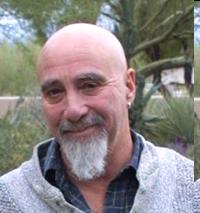 Stuart
Hameroff, M.D., is a doctor of medicine, a professor of
anesthesiology and psychology, as well as associate director of the
Center for Consciousness Studies at University of Arizona. Through a
collaboration with mathematical physicist, Prof Sir Roger Penrose,
Prof Hameroff is leading the assault on mainstream thinking about
the human mind and how it is that we come to be. Forget space
exploration. Forget biotechnology. Forget nanobots. Forget sea
monkeys. The final frontier of science is reading this article right
now - and there's a very good reason why physicists call it "the
hard problem"...
Stuart
Hameroff, M.D., is a doctor of medicine, a professor of
anesthesiology and psychology, as well as associate director of the
Center for Consciousness Studies at University of Arizona. Through a
collaboration with mathematical physicist, Prof Sir Roger Penrose,
Prof Hameroff is leading the assault on mainstream thinking about
the human mind and how it is that we come to be. Forget space
exploration. Forget biotechnology. Forget nanobots. Forget sea
monkeys. The final frontier of science is reading this article right
now - and there's a very good reason why physicists call it "the
hard problem"...
Prof Hameroff was kind enough to take time out of his busy schedule to talk to ObjectMonkey - which surprised me, too. (What was he thinking?)
ObjectMonkey: The thing that really
caught my attention in your work is the notion that our conscious
minds might not be a product of pure computation - well not in the
sense that computer programmers might know it. What is it that makes
us more than just "naughty robots"?
Stuart:
First, what are we talking about? What is consciousness? I mean it
to be our inner life, experience, what it is like to be.
Philosophers call the raw components of conscious experience
qualia.
Why SHOULD computation produce consciousness?
The mind has always been compared to the contemporary vanguard of
information processing. Last century the mind was like a telegraph
switching circuit, then more recently a hologram. Now it's a
computer, and soon will be likened to a quantum computer. A
computerized robot may have a nice sensory processing system to
produce a representation of the external world. But who/what is
observing that representation?
My toaster has a little
computer. The thermostat on my wall computes. I don't believe either
of them to be conscious. But OK, an A.I. type might say, well when
you get to a critical level of computational complexity,
consciousness emerges. There are emergent phenomena - new, novel
properties emerging from simple interactions in a hierarchical
system, like a candle flame from gas and molecular interactions,
wetness from water molecule interactions, hurricanes and tornadoes
from air and dust molecule interactions. So maybe consciousness
emerges from simple interactions among neurons. But none of those
examples are conscious (at least I don't believe them to be). And
there is no predicted threshold or transition for
consciousness.
Some will say, well when we understand the
organization of the brain, we'll have consciousness. But even if you
simulate the activity of every neuron, every synapse, every ion
channel, every molecule in the brain, why should that produce
consciousness? It might, but that's just a supposition based on the
lack of a better idea.
ObjectMonkey:
How did you become involved with Roger Penrose? (or should that
be Prof. Sir Roger Penrose? Or Sir Roger? Or just
"Sir"?)
Stuart: Well, Roger HAS a better idea.
(He's completely non-egotistical, and was embarrassed, though
appreciative when he was knighted. When you get to know him, he's
just "Roger"). He suggested (arguing from Gdel's theorem) that to
account for human choices which are not strictly algorithmic, nor
random, one needed a particular type of quantum computation in the
brain.
The idea was that quantum superpositions of
information states (quantum bits or qubits) in the brain would reach
threshold for his (proposed quantum gravity
mediated) reduction,
and that the collapse or reduction would result in choices of
classical states which would be neither completely algorithmic, nor
random, but include influence by Platonic information embedded in
the universe. He called this type of choice non-computable, and
argued that it was characteristic of human conscious choices and
perceptions. I've just reduced several hundred pages of detailed
logical arguments into a few sentences, so I'd suggest one read his
books.
But he didn't have a particularly good biological
candidates for his qubits, and suggested that perhaps neurons could
possibly be in quantum superposition of both firing and not firing.
I had been studying neurons and structures inside neurons called
microtubules which I believed to be ideal information processors
supporting neuronal activities from within. A neuron is far more
complex than a simple on-off bit state. If you think about a single
cell like a paramecium which can swim, learn, avoid predators, find
food and mates and have sex, it has no synapses. It's just one cell.
It uses its microtubules as information processors.
My point
had been that each neuron, with roughly 10 to the seventh
microtubule subunits switching every nanosecond provided 10 to the
sixteenth operations per second PER NEURON. A.I. types trying to
simulate the brain had been assuming 10 to the eleventh neurons, 10
to the 3rd synapses per neuron, switching every 10 milliseconds max
for a total brain capacity of roughly 10 to the sixteenth operations
per second. So I was saying each neuron matched what they were
targeting as total brain capacity. I was (and am still) rather
unpopular among A.I. types.
But people would say to me "so
how does that explain consciousness?" And of course, it
didn't.
So I thought maybe Roger had the mechanism and I had
the biological structure, and that microtubules might be his quantum
computers. So we teamed up to develop a model.
ObjectMonkey: The thing that spurred me on to
find out more about your work was a BBC documentary I saw a couple
of years ago. I may have got this wrong - I usually have - but
didn't the program suggest there was clinical evidence that our
consciousness might "leak out" of the brain under certain
conditions? What was the nature of this
evidence?
Stuart: Several clinical studies had
looked at patients who had cardiac arrests but were revived and then
reported "out of body" experiences. The percentage was about 17
percent of all cardiac arrest cases. They nearly all reported the
same things - white light, sense of calm, tunnel. In some cases they
reported floating above the room, or out into the hospital waiting
room observing their family. In some cases they reported events or
conversations which occurred when their brain was not functioning,
and/or in another room.
The BBC asked the clinicians who
conducted the studies how they could explain this, and they said
"ask Penrose and Hameroff". I told them that, according to our
model, consciousness was occurring at the level of quantum gravity,
at the fundamental (funda-mental) level of space-time geometry at
the Planck scale, where - we propose - proto-conscious qualia and
Platonic information are embedded. So when the brain metabolism
fails and microtubule quantum coherence is lost, the quantum
information is no longer confined to the brain and "leaks out" into
space-time geometry at large, still bound by quantum
entanglement.
ObjectMonkey: Other
reading I did into the nature of consciousness and particularly the
relationship between physics and mind have suggested that
"materialism" - the belief that the mind is a product of physics -
is a prejudice. Indeed, in Roger Penrose' book "The Large, The
Small, and The Human Mind" he admits that it is. Have you ever
entertained the converse view that physics may be a product of
consciousness? Or is that just TOO weird?
Stuart:
I agree that the idea that the mind is a product of physics "as
we know it" is a prejudice, just like the idea that the mind is a
product of computation. We need new physics, like Roger's ideas of
quantum gravity objective reduction in which consciousness is a
process occurring on the edge between the quantum and classical
worlds.
Idealism is the notion that the mind produces the
world. Bishop Berkeley is the philosopher most associated with this
idea, which is similar to Hindu beliefs. Positivism is the similar
notion that the mind constructs our reality. The Copenhagen
interpretation of quantum mechanics is basically
positivist.
ObjectMonkey: Another
very bizarre idea to have emerged from your field of research is how
our perception of time might not be quite as linear and objective as
we think. How can I feel my feet hit the ground at the same
time I see them hit the ground? Surely my sense of touch is
much slower than the speed of light?
Stuart:
Good question. There are three types of answers. One is that the
fast (visual) information is delayed to match the slow, tactile
information. Thus we are "living in the past" slightly. This would
be disadvantageous from an evolutionary standpoint. (Imagine two
boxers, one a half second slower reacting.)
The second is
that we see and feel etc separately, out of kilter, but just
remember the sensations as being synchronized. This is the
"Orwellian revisionism" idea put forth by Dan Dennett. Our conscious
sense of reality is an illusion.
The third was suggested from
experiments by Ben Libet in the 1970s on patients having brain
surgery while awake, their scalp and skull numbed. Libet would, for
example, stimulate their left pinky finger, record from the
corresponding right sensory cortex, and ask them precisely when they
felt the stimulus (he had a clever way of eliminating reporting
delay). He would then directly stimulate that part of right sensory
cortex and ask when they felt it. You would expect that the finger
stimulation would be delayed, and the cortical stimulation would be
felt immediately. But the results were just the opposite. The finger
stimulation was reported immediately, and the brain stimulation was
delayed. Libet concluded that the brain refers information backwards
in time. So in your walking example, the slow tactile sensations
from the feet are referred backwards in time, i.e. from the near
future to the present.
If consciousness is a series of
quantum state reductions, then no problem, as time is indeterminate
between reductions. Another way of looking at it is Aharonov's idea
that each reduction sends two vectors of information, one forwards
and one backwards in time. This referral from the near future may be
the only way to explain a baseball batter hitting a 100 mile per
hour fastball from 60 feet. Someone looked at that and showed that
it is impossible by conventional neurophysiology. It may be the same
for cricket.
ObjectMonkey: Some would argue that if
you want to find a civilization that understands mass-energy
equivalence, you just look for the mushroom clouds. What might be
the signature of a civilization that has a practical understanding
of consciousness?
Stuart: Well, they could
construct artificial media for consciousness, using e.g.
fullerene-based quantum computers. So when the body died,
consciousness could be transferred for an indefinite existence,
perhaps operating robots. But on the other hand if it were
appreciated that consciousness persists anyway in fundamental
space-time geometry, there would be no need for such artificial
media. It could be a very content, spiritual society.
ObjectMonkey: I recently read Rupert
Sheldrake's book "The Sense Of Being Stared At", which puts forward
clinical evidence that the mind can extend beyond the brain while
we're awake. Are you familiar with his work? Is it just possible
that the effects you talked about when a patient's brain metabolism
fails might also occur under other
circumstances?
Stuart: I am somewhat familiar
with Rupert Sheldrake's work, and would very much like to see
clinical evidence that the mind can extend beyond the brain. I'll
have a look at it. Thanks.
I do believe it is possible, and
may occur all the time. Phenomena such as telepathy can be explained
by quantum entanglements which are inherently non-local. The trick
is how two people can become entangled. But fundamental space-time
geometry may be inherently non-local, and so our sense of spatial
separation may be somewhat illusory.
ObjectMonkey: President Bush - bless his little
cotton socks - has announced recently a renewed effort to put men
back on the Moon and eventually on Mars. If you had that kind of
budget at your disposal, what would you do with
it?
Stuart: Well, I'd save Social Security,
boost healthcare, education and the environment. And I'd try and
find a cure for arrogance. As far as science, the only reason Bush
wants to put men on the moon and Mars is most likely military. He's
worried the Chinese will get there first. I'd revamp the NIH, NSF
and other funding agencies so researchers aren't herded into
cubbyholes.
ObjectMonkey: Will
Quantum Computers ever be capable of consciousness, or is there
still something missing from the mix?
Stuart:
The key is Penrose objective reduction, sustaining
superpositions long enough (avoiding decoherence via isolation or
other means) to reach threshold for self-collapse, thus connecting
to fundamental space-time geometry. Technological quantum computers
as presently envisioned will reduce by measurement, introducing some
randomness which can be averaged out by redundancy.
The
threshold for consciousness is given by the indeterminacy principle
E = h/t, where E is the gravitational self energy of the
superpositioned mass, h is Planck's constant (over 2 pi), and t is
the time until reduction. E and t are inversely related. So, a large
superposition will reach threshold for a conscious moment quickly,
and a small superposition will require a long time. In both cases
the superpositions must be isolated from environmental decoherence.
An isolated superpositioned electron would reach threshold and have
a conscious moment (albeit a rather dull one) only after 10 million
years. An isolated one kilogram superposition (e.g. Schrdinger's
cat) would reach threshold after only 10 to the minus 37 seconds -
too fast to notice.
In the brain we have the right balance -
an amount of superpositioned tubulin proteins in microtubules which
can be isolated inside neurons to reach threshold every 25
milliseconds or so, i.e. 40 times per second, corresponding with the
well known coherent 40 Hz brain oscillations.
Quantum
computers as presently designed will have superpositions of
electrons, so E will be small and t will be very long. So they won't
reach threshold before they are measured. However it is conceivable
that a quantum computer using fullerene technology could have enough
superpositioned mass - a large enough E to do so, to reach threshold
for consciousness in a reasonably short time.
ObjectMonkey: Have you ever watched "I'm a
Celebrity... Get Me Out of Here?" Is it just possible that some
people aren't conscious at all - even though they may appear to be?
Is it possible to appear self aware when you're really not? Could
consciousness be artificially
suppressed?
Stuart: Philosophers call such
entities "Zombies". They may have complex behaviors, but no inner
experience (like the android Commander Data on Star Trek). It has
occurred to me that materialist philosophers like Pat Churchland and
Dan Dennett may in fact be zombies. At the conferences "Toward a
Science of Consciousness" we have every two years in Tucson (the
next one coming up in 2 months, April 7-11, 2004 - see http://www.consciousness.arizona.edu/)
Dave Chalmers and I have held a consciousness poetry slam and
usually do renditions of what we call "The zombie blues", sung to
the tune of George Thoroughgood's "Bad to the bone", (you know, a
verse then, Dah DA, dah DUM). The first verse starts out
"I
look like you look",
audience: Dah DA, dah DUM
"I do what
you do"
Dah DA, dah DUM
"But I'll never know"
Dah DA,
dah DUM
"What its like to be you!"
Dah DA, dah
DUM
"That's cause I got the Zombie Blues"
And so
on
Participants are encouraged to make up their own verses
and perform them. Several verses have been a bit off color, based on
the idea that zombies can have sex, but cannot have orgasms.
Actually I suspect that sexual experience may have been the first
qualia in evolution. What better way to promote reproduction and
survival of the species?
ObjectMonkey:
Roger argues in his book that creativity and intuition are
non-computable products of consciousness. Is there some aspect of
our brains that might make some people more creative/intuitive than
others?
Stuart: A host of things might help,
like native intelligence, genetics, environment, personality, all of
which would allow some to take more advantage, be more tuned in to
the Planck scale Platonic realm. Or it may be an isolated trait,
like savants. Julian Jaynes wrote in "Origin of consciousness and
breakdown of the bicameral mind" that, prior to a few thousand years
ago, people lacked a "self" and listened to voices in their heads.
Maybe they were tuning into the universe. Some still can, but others
drown it out. There are implications for spirituality as well.
ObjectMonkey: Out of the following,
which would you say is the greatest invention of the modern
age?
a) TV
b) Computers
c) Furbees
d) X-Ray
Specs
Stuart: I'm not sure what a Furbee is,
but I wrote a chapter in a book "Greatest Inventions of the Past
2000 Years" edited by John Brockman. I nominated anesthesia,
invented in the mid 19th century. What if you needed surgery, or
even possible needed surgery and there was no anesthesia? Among your
list I'd go with computers.
ObjectMonkey: Currently, I'm reading "The Very
Hungry Caterpillar" by Eric Carle. I like the pictures, but it's a
little heavy going in places. What book are you reading at the
moment, and who do you get to help you when you get stuck on a big
word?
Stuart: I'm in the midst of several,
laying around the house. They include Al Franken's "Lies and the
lying liars who tell them: a fair and balanced look at the right",
"The coming anarchy" by Robert Kaplan, "God and the new physics" by
Paul Davies, and one whose name and author escape me, but is about a
traveling freak show family whose members' self esteem relate to the
degree of their anatomical abnormalities. The last book I finished
was "The DaVinci code".
If stuck on a word I'd ask my
girlfriend Samantha. I'll ask her what a Furbee is.
ObjectMonkey: What's your favourite restaurant,
and why?
Stuart: A hole-in-the-wall Mexican
restaurant in south Tucson called "El Torero". Its got great
chimichangas, cold beer, bullfight posters and a huge swordfish on
the walls.
ObjectMonkey: In the
interests of science, I've devised some ingenious experiments which
you might like to try:
a) Wear a
tweed jacket and a bow tie to work. Smoke a pipe and offer anyone
who comes in to your office a glass of sherry. Have a pot of tea and
a selection of cakes delivered at 4pm prompt every afternoon. Refer
to everybody as "my good man" or "my dear lady". Observe the
reactions of your colleagues and write them down in a little book.
When the book is full, count the number of times you used the word
"stare". If my theory is correct, you will have used it more than
once, but less than a billion times.
b) Run up and down
stairs many times until you become very tired. If my estimates are
accurate, this should take between 1 and 360 minutes.
b) Soak
all your clothes in vinegar. If my predictions are sound, they
should last longer.
Let us know how you got
on.
Stuart: I'll get right on
them.
ObjectMonkey: After a hard
day's being, here at Monkey Towers we like to glue almonds on to the
lapels of our zoot suits, drink precisely 9.4 hectares of Crme de
Menthe - which you might want to jot down - and then head off in our
second-hand Batmobile to Matt Damon's holiday caravan for a game of
Buckaroo. How do you like to wind down?
Stuart:
Exercise. I play - not that well - basketball, golf and
tennis.
ObjectMonkey: How many
times have you seen Star Wars?
Stuart: Not
sure, but I actually read the original book way back when. The cover
notes said they were going to make it into a movie. I said "No way".
The same thing happened with Jurassic Park.
ObjectMonkey: If you could have your time over
again, how bored would you be? ("Yeah. Been there. Seen it. Done
that. Yada yada yada...")
Stuart: If I don't
see you in the future, I'll see you in the pasture.
ObjectMonkey: Lastly, and most importantly -
when was the last time you ate candy floss? (I believe you call it
"cotton candy")
Stuart: Probably at a
University of Arizona Wildcat basketball game when we were safely
ahead of the opponents.
The original article as posted by Object Monkey can be found at http://www.objectmonkey.com/?A=getcolumnpiece&Ar=p=43%5Ec=6%5Ei=15%5E